Stop reacting to the news. Start anticipating the market.
Why would you need two monthly publications?
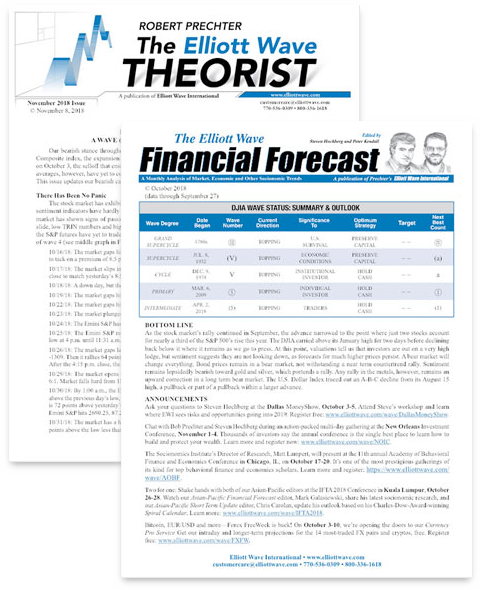
To keep you continually informed, The Elliott Wave Theorist and The Elliott Wave Financial Forecast leapfrog each other throughout the year. The Forecast comes out at the start of each month, and the Theorist comes out mid-month.
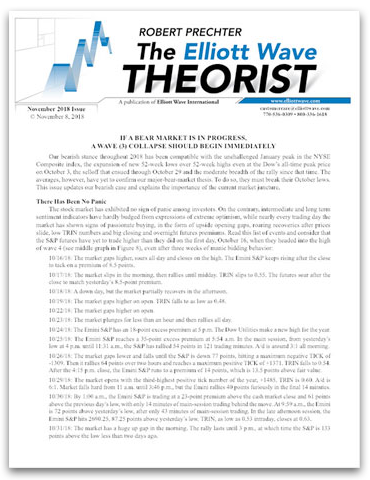
The Theorist has been published continuously since 1979 by Elliott Wave International’s Founder and President, Robert Prechter, and provides macro perspectives on the markets and society. Each issue focuses on which markets matter most right now.
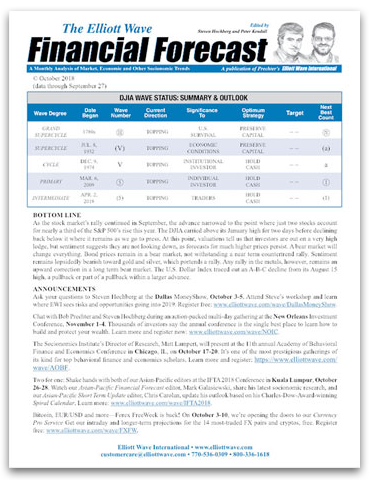
The Financial Forecast, co-written by Steven Hochberg & Peter Kendall, provides a longer-term view of U.S. stock indexes, bonds, gold & silver, the U.S. dollar, inflation vs. deflation, macroeconomic trends, and even cultural indicators such as the popularity of movie genres, pop stars and U.S. presidents. How cool is that?
Together they’ve helped subscribers navigate bull and bear markets, financial crises, speculative manias and major social trends for decades. The result is a steady flow of insights designed to help readers understand where markets and society may be headed next — and why.
If you are active in the markets, we also recommend the Short Term Update
Editor Steven Hochberg calls it a “bridge between the monthly issues.”
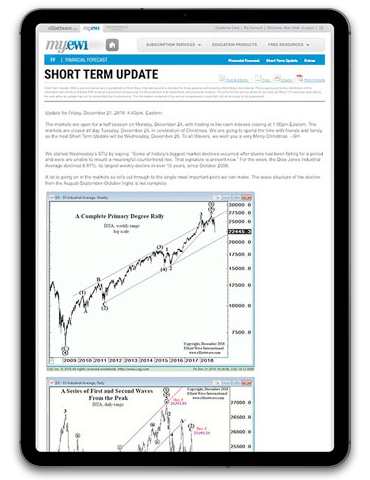
Every Monday, Wednesday and Friday, the Short Term Update delivers concise analysis and updated Elliott wave charts of where all the key markets may be headed in the next few trading sessions—while flagging any important shifts in outlook along the way.
Subscribers rely on the Update to stay aligned with the market’s evolving wave structure. You will too.
Subscribe now and get instant access to recent issues, so you can get right up to date.
Meet The Flagship Services Analytical Team

Robert R. Prechter Founder and President, Elliott Wave International
Robert Prechter’s name is familiar to market observers the world over. Prechter has shared his market insights in The Elliott Wave Theorist since founding Elliott Wave International in 1979. Prechter developed a theory of social causality called socionomics, whose main hypothesis is that endogenously regulated waves of social mood prompt social actions. In brief, events don’t shape mood; mood shapes events. Prechter has co-authored several academic papers and written 20 books on finance and socionomics, including a New York Times bestseller. You can find a full bio at www.robertprechter.com.

Steven Hochberg Chief Market Analyst
Steven Hochberg co-writes our monthly Elliott Wave Financial Forecast and issues our Monday-Wednesday-Friday Short Term Update. As a foremost expert in Elliott wave forecasting, Steven is a sought-after speaker at investment conferences. He has been interviewed by Barron’s, Bloomberg, CNBC, MSNBC, The Los Angeles Times, The Washington Post and other media outlets. Steven began his career at Merrill Lynch and joined EWI in 1994.

Peter Kendall Chief Analyst for U.S. Markets and Cultural Trends
Peter Kendall places financial markets within the larger context of trends in social mood. From the heights of skyscrapers, roller coasters and hemlines to the depths of politics, pop music and divorce rates, Peter shows how these elements elucidate waves of social mood, which in turn coincide with financial trends. Peter co-edits our monthly Elliott Wave Financial Forecast and on occasion contributes to the Short Term Update. Peter began his career writing for the OTC Stock Journal and joined Elliott Wave International in 1992.
View Some Of Our Notable Market Forecasts
For more than 45 years, these publications have identified many bullish and bearish opportunities for their subscribers — often when the crowd was most convinced of the opposite.
Not all our forecasts work out, but we challenge you to find another service this dedicated to getting it right time after time. Here are some highlights:
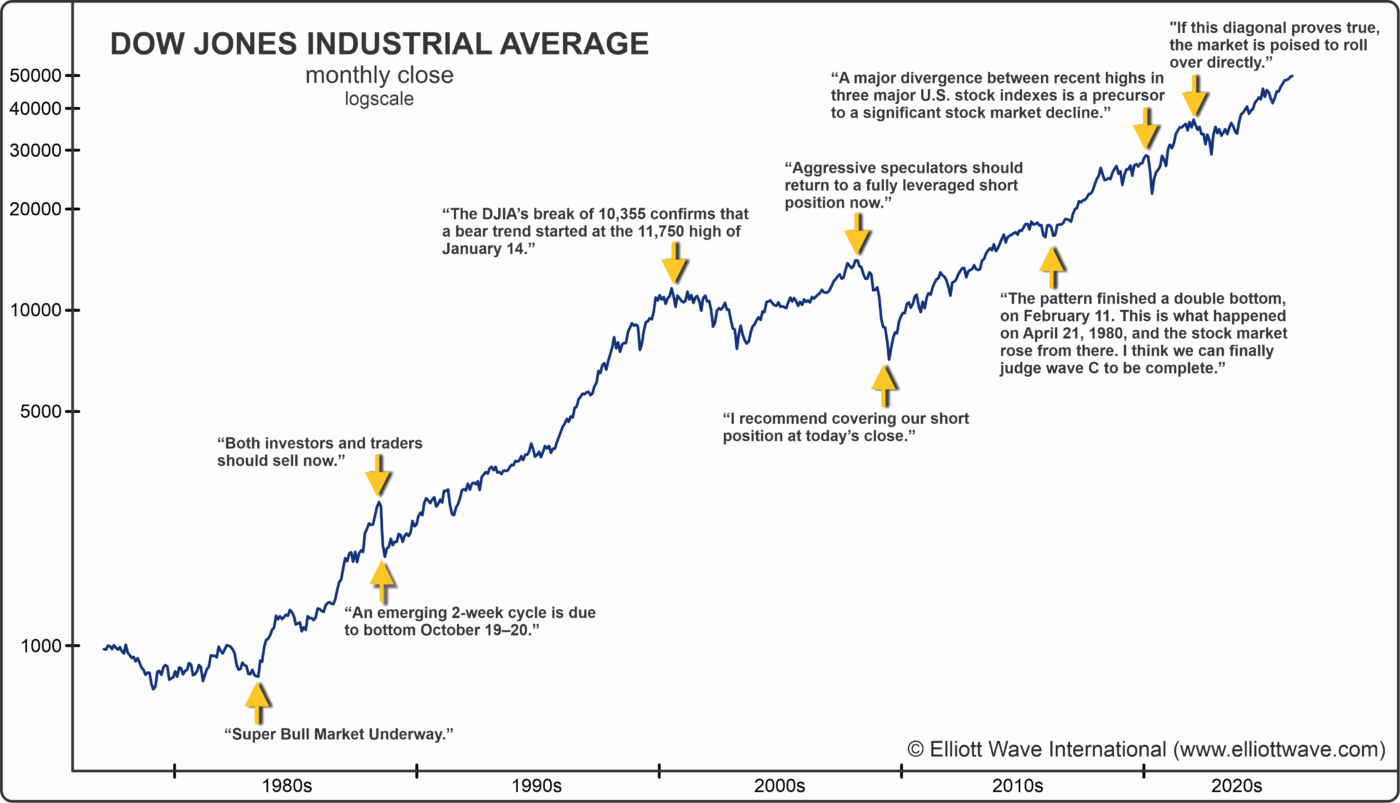
Gold’s Historic Rise
In early October 2023, statistics showed that 90% of traders were bearish on gold. Our Flagship Short Term Update, however, had identified an “approaching wave 2 low” — signaling that a powerful wave 3 rally was likely next — and alerted subscribers to the opportunity.
Analysis/Forecast:
October 4, 2023:
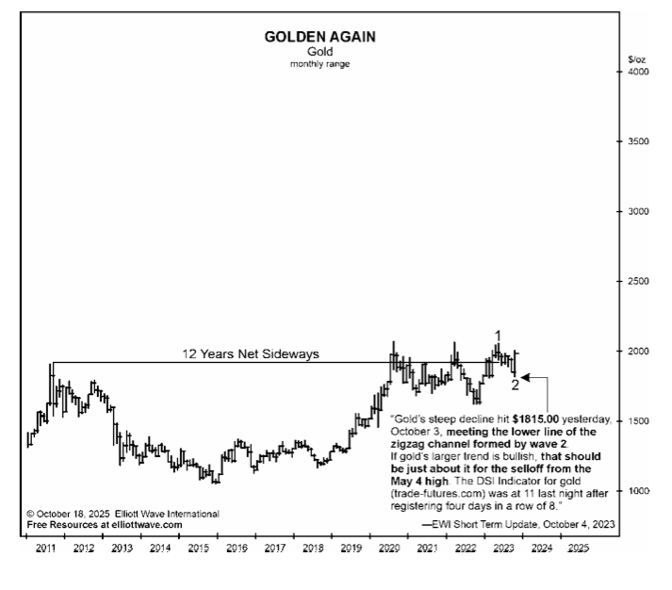
“Gold’s steep decline hit $1815.00 yesterday, October 3, meeting the lower line of the zigzag channel formed by wave 2. If gold’s larger trend is bullish, that should be just about it for the selloff from the May 4 high. The DSI Indicator for gold (trade-futures.com) was at 11 last night after registering four days in a row of 8.”
What Happened Next?
Wave 2 had bottomed that very day:
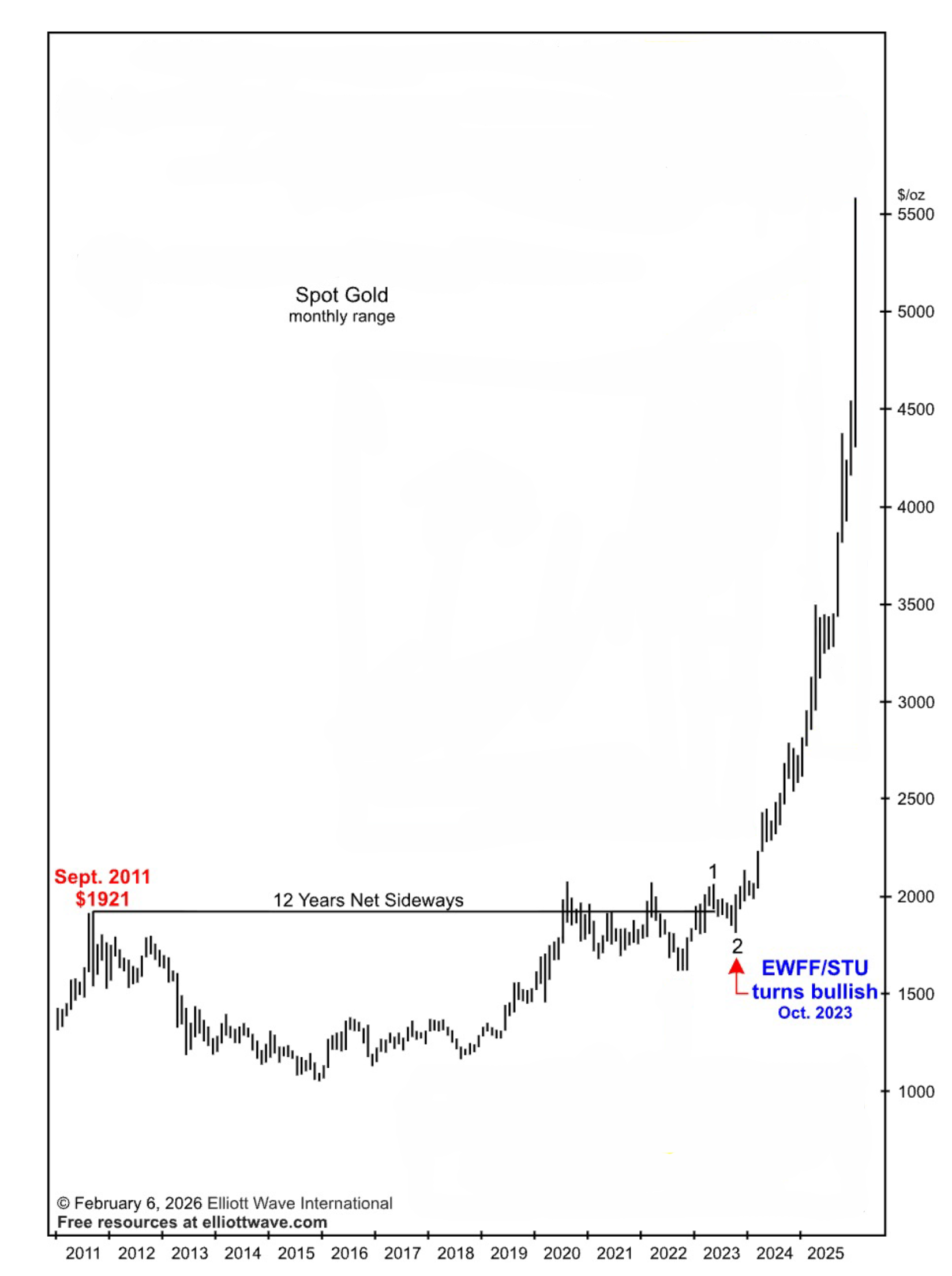
By October 2025, gold had traded above $4,000/ounce and later surged to a record high above $5,600 — nearly tripling as the larger bull market structure unfolded.
Silver’s “Major Spike“
In April of 2023, few investors were paying attention to silver. Our Flagship Services, however, were identifying the metal as one of the most overlooked opportunities in the financial markets.
Analysis/Forecast:
In April 2023, The Elliott Wave Theorist declared:
“Silver is probably the only commodity on earth selling for less than it did 43 years ago… Among all the world’s seasoned investments, it is the cheapest. Stocks are a religion. Property is a religion. Bitcoin is a religion. Nobody is paying attention to silver.”
One year later, in the April 2024 issue of The Elliott Wave Financial Forecast confirmed:
“Silver should trend with gold, and this week’s sharp advance indicates that prices are starting to align.”
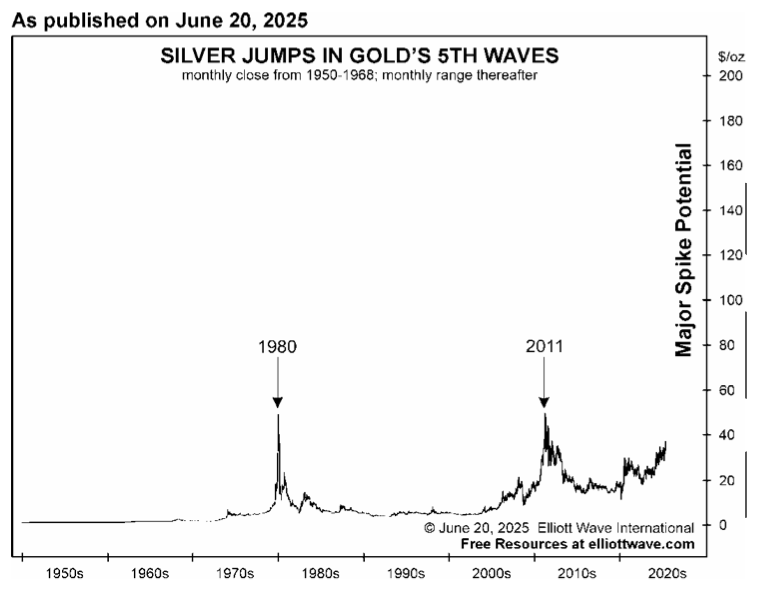
Then in June 2025, EWT showed this chart and told subscribers of a “Major Spike Potential” in the metal:
What Happened Next?
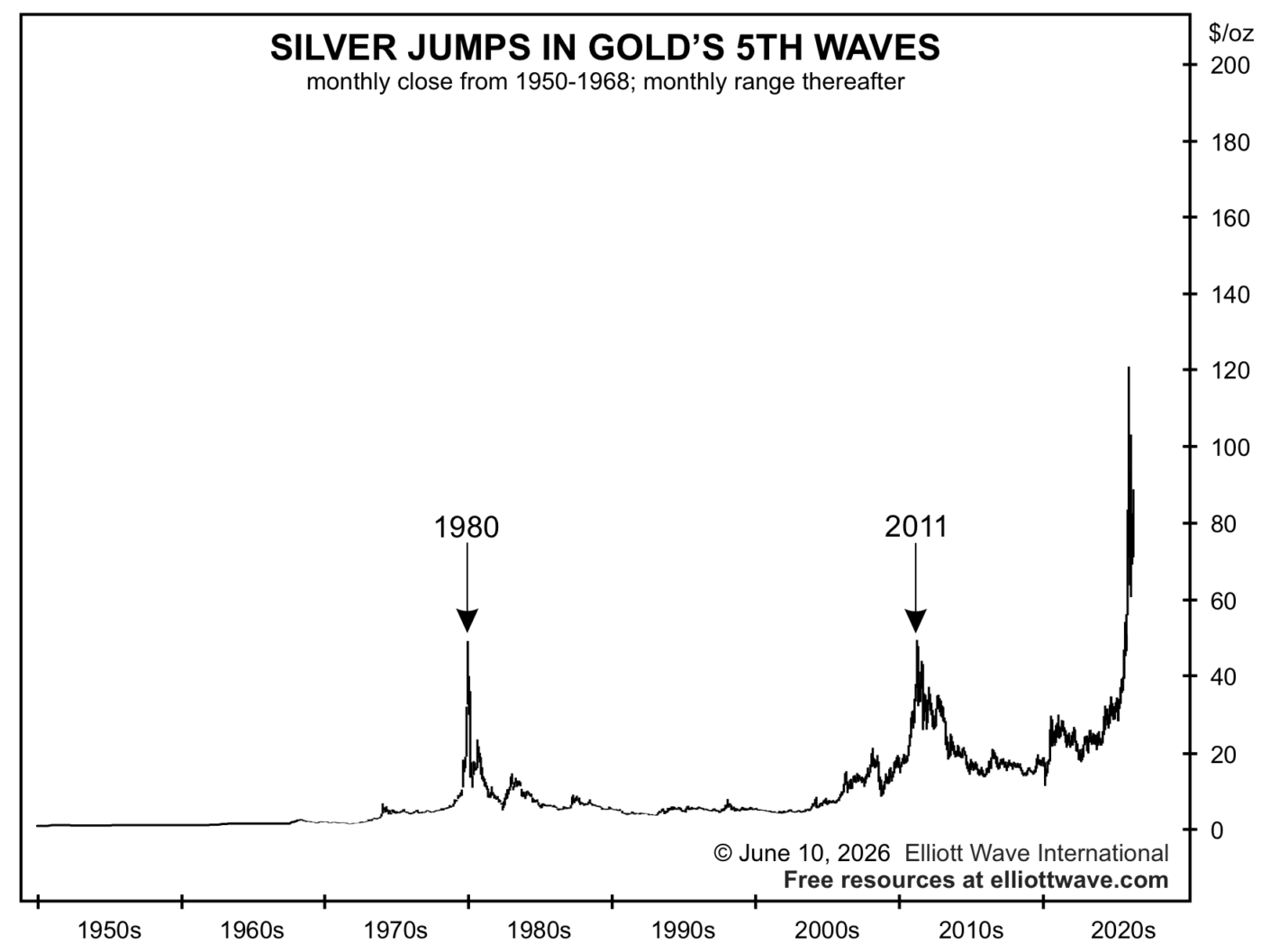
In October 2025, silver finally exceeded its 1980 all-time high, trading above $53/oz for the first time in more than four decades.
The breakout marked the beginning of a historic advance as silver eventually surged above $120/ounce in early 2026 — a move of roughly +400% from the time The Elliott Wave Theorist first highlighted the opportunity in April 2023.
Our forecasts were on this move early — and accurately.
Interest Rates – The End of an Era
In September 2020, the Federal Reserve assured the public that interest rates would remain near zero for years. The consensus view was that ultra-low rates would persist indefinitely — a belief reinforced by weak inflation readings and the Fed’s aggressive monetary stimulus following the pandemic shock. Here’s what The Elliott Wave Theorist said to subscribers:
Analysis/Forecast:
September 23, 2020:
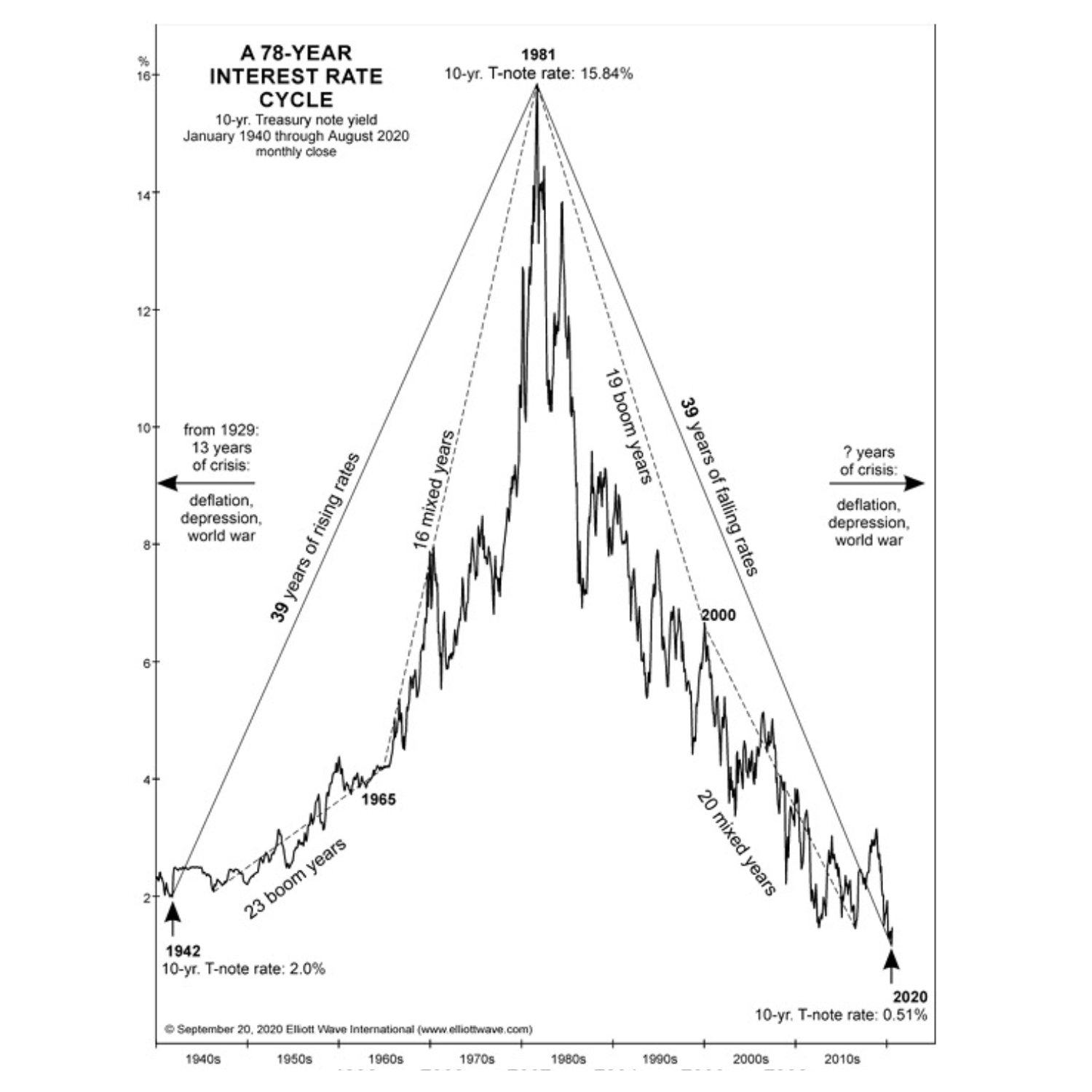
“On September 16, Fed Chairman Powell…told reporters that he expected short term interest rates to stay near zero…through “the end of 2023.”
“…there is not a chance in the world of that scenario playing out. [T]he probability is high that interest rates have begun a process of rising….
What Happened Next?
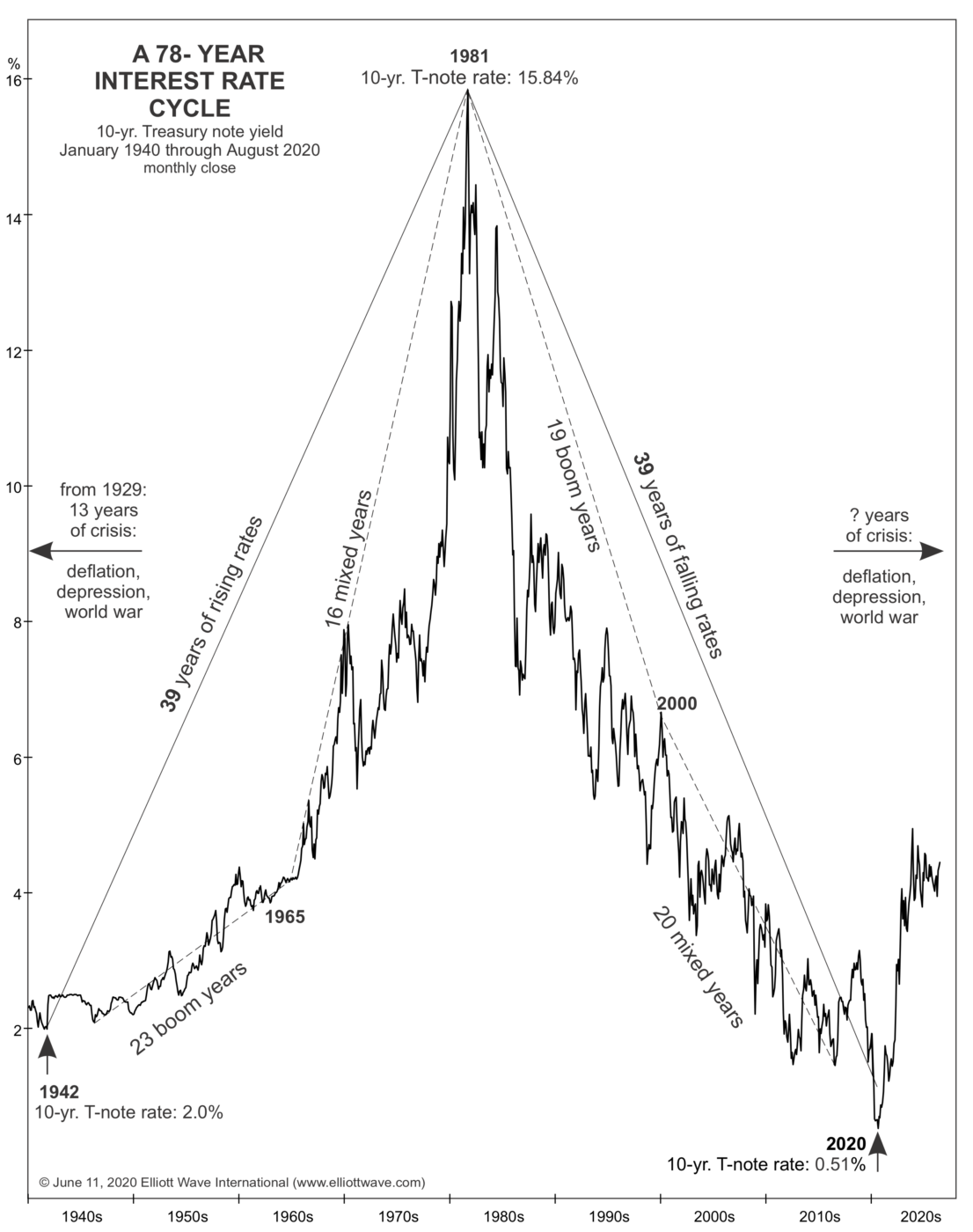
Long-term interest rates began to climb soon after. By early 2021, yields on Treasury securities were rising across the board. Over the next 18 months, T-bill rates — which had hovered near 0% — soared above 5%, marking one of the fastest rate reversals in modern history.
The forecast not only anticipated the end of a 40-year era of falling rates, but also signaled a rare opportunity for individuals and businesses to refinance, secure long-term loans, or lock in historically low borrowing costs before the sharp surge ahead.
Alerting Readers to Bitcoin at 6 Cents
In 2010, few had even heard of Bitcoin. The mainstream press ignored it, and “digital money” was viewed as a curiosity or a fad. In a special issue of The Elliott Wave Theorist published on September 17, 2010 we said:
Analysis/Forecast:

Bitcoin Electronic Currency:
The Future of Money
by Elliott A. Precther
“Cryptography expert Satoshi Nakamoto has created the first completely decentralized, anonymous electronic currency, called Bitcoin…
Bitcoins have the necessary features of money: medium of exchange (anonymous and across great distances), unit of account (private), divisibility (up to eight decimal places), scarcity (21 million), portability (transferred electronically), and store of value (current exchange rates – as of August 2010 – show 1 Bitcoin, or BTC, equal to 0.065 USD).
While Bitcoin appears to have enormous potential as currency, it will have to stand the test of time and the marketplace. Even if Bitcoins do not catch on in the mainstream, the structure has the virtue of providing an example of a decentralized monetary alternative. As distrust in central banks continues to increase as the financial crisis drags on, the idea of private currencies should grow in popularity.”
What Happened Next?
Unless you’ve been living under a rock, you know that Bitcoin rose from roughly $0.06 to a high over $124,000— a 2,074,000%+ increase from when The Elliott Wave Theorist introduced it to subscribers. Imagine what buying just $100 worth of bitcoin back in 2010 and holding could have meant to you.
In fact, you don’t have to imagine it – read this testimonial:
“I’m a keen subscriber to Elliott Wave Financial Forecast and Theorist. I print them out every month, sit down and read every line.
Well, Back in September 2010 I received the Theorist and read the article about Bitcoin…
I seriously thought about buying some Bitcoins. But, I hesitated... Later I cursed myself for that decision.
BUT, it got me interested in Bitcoin and the whole Cryptocurrency world. Later, in 2015, I finally took the plunge. I bought 50 Bitcoin at US$250 each.
Plus, I bought a whole raft of other cryptos: Ripple, Doge Coin, REDD coin, DASH, and etc. All of these exploded in value...
The result is that my wife and I now have a VERY comfortable retirement.
It is ALL due to the fact that I read that issue of “The Elliott Wave Theorist” back in 2010. SO, A REALLY BIG THANKS to Bob Prechter and everyone at ElliottWave.com.
— David H.
Bitcoin Mania – The First Bubble
In December 2017, Bitcoin fever reached full-blown mania. Global media declared it “the future of money.” The launch of Bitcoin futures on the CME and CBOE was hailed as Wall Street’s stamp of approval. Here’s what The Elliott Wave Financial Forecast said to subscribers:
Analysis/Forecast:
December 1, 2017:
“A market that looks and quacks like a bubble is a bubble. With a surge of 1130%, no market in history has bubbled the way bitcoin has over the past 11 months…
In a classic sign of a terminating mania, even the most novice of investors is now piling into bitcoin.”
Bitcoin’s rise from 2011 should eventually be followed by a clean break of the exponential curve drawn on the chart.
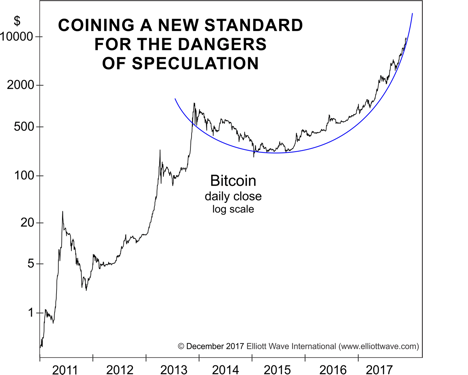
A breakdown from the bowl should lead to a bitcoin bear market…”
What Happened Next?
Bitcoin would hit its peak just 16 days later. A few days after that top, Elliott Prechter said in interview with Newsmax:
“I Wouldn’t Touch Bitcoin — Risk of Collapse Too Big.”
— Newsmax, December 21, 2017
Then, in early January 2018, our Elliott Wave Financial Forecast published a special section titled “Bitcoin: The Greatest Bubble of All Time” and said:
January 5, 2018:
“On December 1, GMP cited a ‘rising sea of euphoria, ever-higher price projections and the capitulation of financial sophisticates’ as a powerful combination of forces that would mark the demise of bitcoin’s incredible upward trajectory…
Is the bitcoin mania really over? The odds are high that it is…”
Overall, from it’s peak, Bitcoin plunged more than 80%, bottoming near $3,200 in December 2018.
By January 2019, the “crypto winter” narrative dominated — confirming the warnings EWI issued at the height of euphoria.
Collapse in Crude Oil
By mid-2008, crude oil had become the world’s hottest trade. Prices had risen seven-fold in six years amid “peak oil” headlines, record speculative inflows, and near-unanimous belief that $200 per barrel was inevitable. Sentiment hit extremes — on July 2, 2008, just nine days before the top, the DSI showed 97% bulls among oil-futures traders. Here is what The Elliott Wave Theorist said to subscribers on June 8, 2008:
Analysis/Forecast:
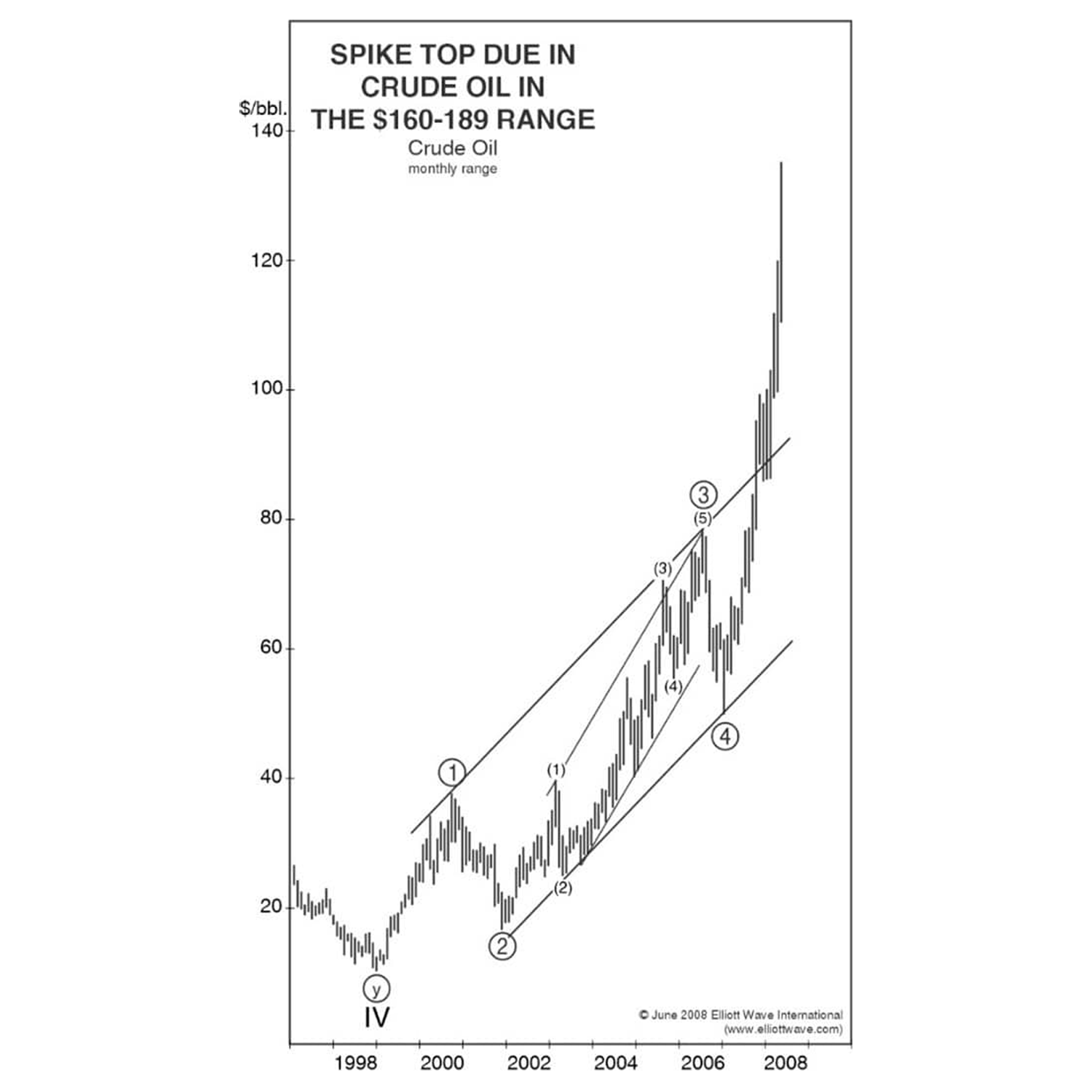
The Top of Wave 5 in Crude Oil Is Fast Approaching
“I am publishing this issue a bit early in order to alert you to an opportunity developing in the oil market. Bull markets in commodities virtually always end with an extended fifth wave, as explained in Chapter 6 of Elliott Wave Principle. So, one of the greatest commodity tops of all time is due very soon. Ideally, crude oil should end on a violent spike high in the $160-$189 range.
What Happened Next?
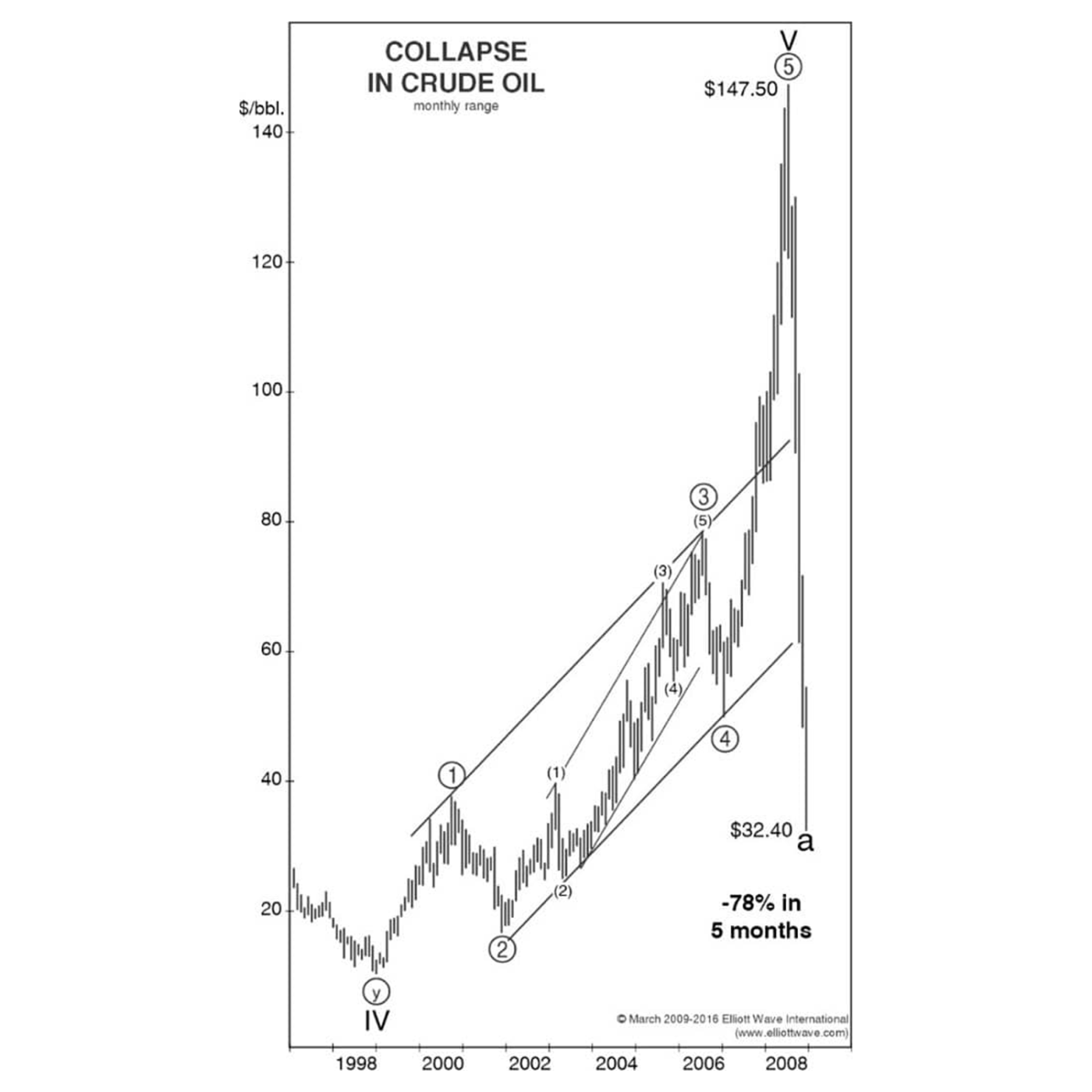
And just one month later, on July 11, 2008, oil hit its final high and shocked the world with a breathtaking 78% crash in 5 months.
U.S. Dollar Index’s “Multi-Month Decline”
By late 2024, the U.S. Dollar Index had been climbing steadily, with traders and commentators describing the rally as “unstoppable.” Economic data and global uncertainty fueled widespread belief that the dollar’s strength would persist well into 2025. Here’s what our Short Term Update said to subscribers:
Analysis/Forecast:
January 13, 2025:
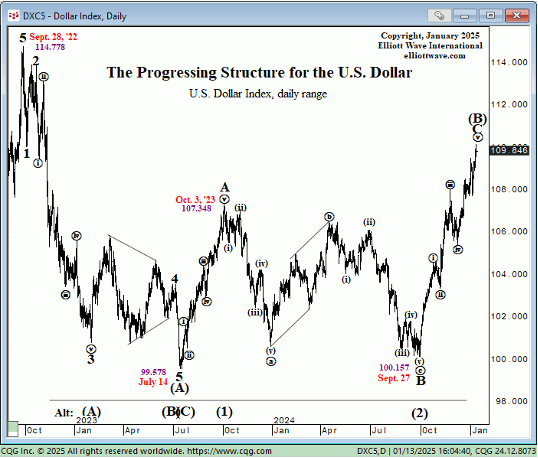
“… the next major move will be a multi-month decline that draws the index below 99.578.”
What Happened Next?
The Dollar Index peaked that very day:
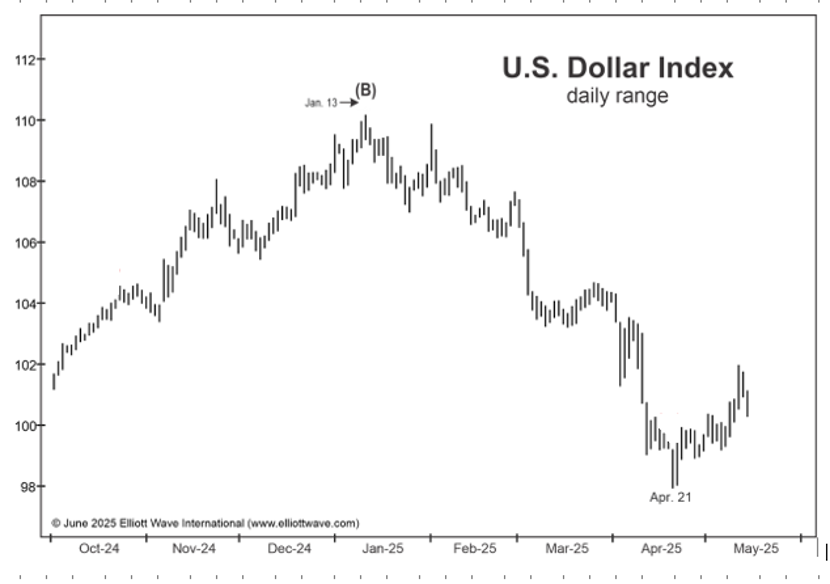
As forecasted, the multi-month decline that followed plunged the index below 98 by April 21 –a three-year low.
Robinhood Markets Inc. (HOOD)
As optimism toward the Robinhood Markets Inc. (HOOD) stock reached a new extreme, analysis from our Elliott Wave Finanical Forecast identified signs that the rally was likely nearing completion.
Analysis/Forecast:
October 31, 2025:
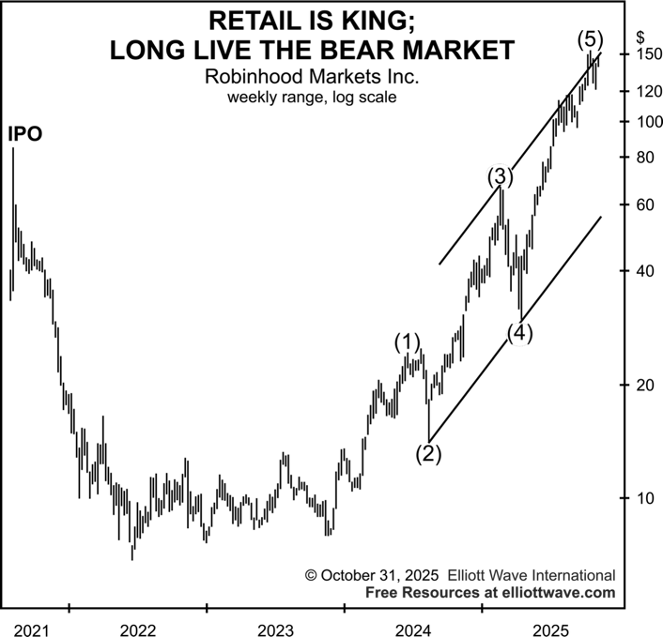
“…the five-wave form of Robinhood’s rally to a new all-time high on October 6 suggests its latest rise is ending. King Retail should quickly celebrate its latest position on top because it is all about to change.”
What Happened Next?
The warning proved timely:
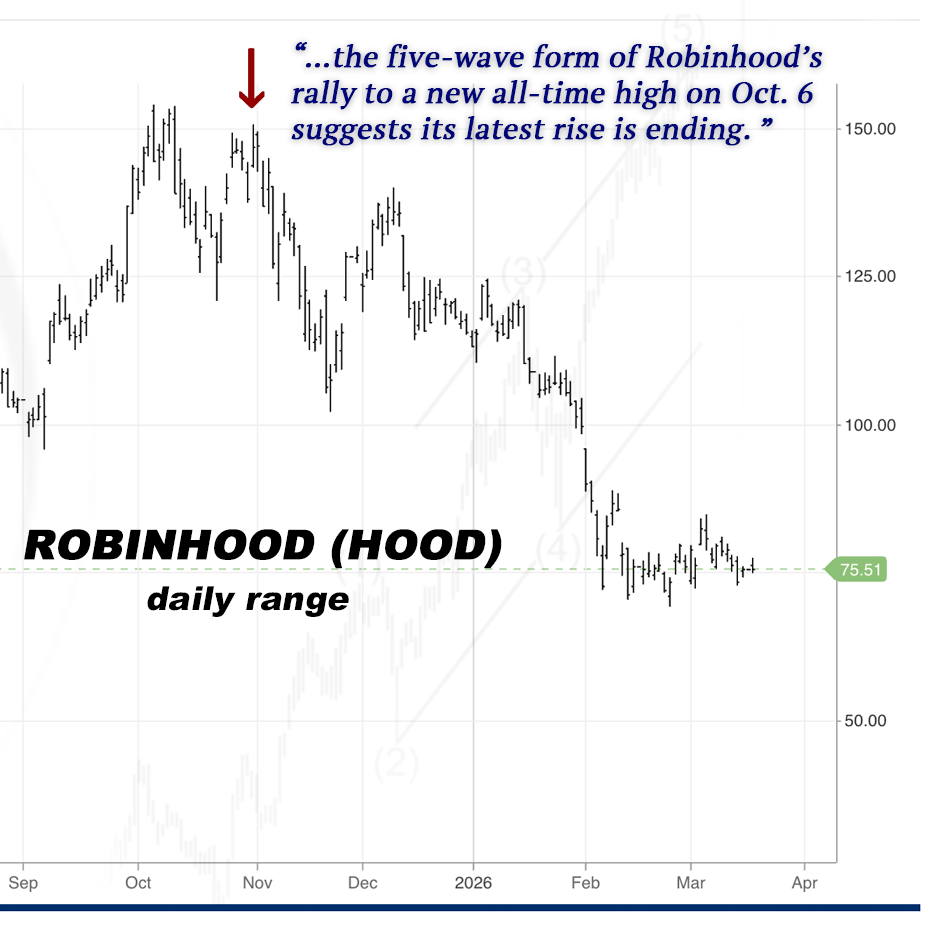
By February 24, 2026, HOOD had declined to an intraday low of $69.22 — a drop of roughly 55% from the October peak.
View Subscriber Testimonials
What Do I Get With A Subscription?
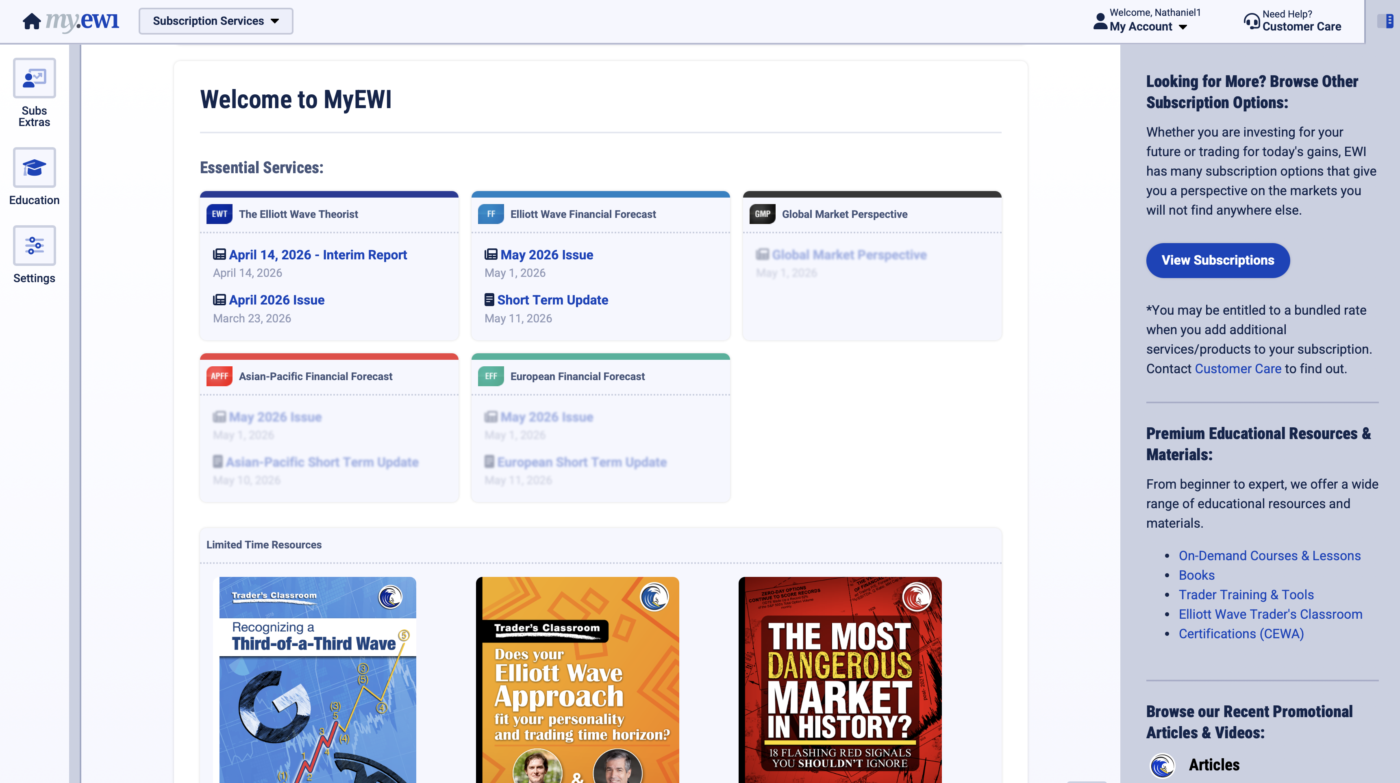
Immediate access to the latest issues, so you can get up to speed quickly. From there, you’ll be notified whenever a new issue or update is published.
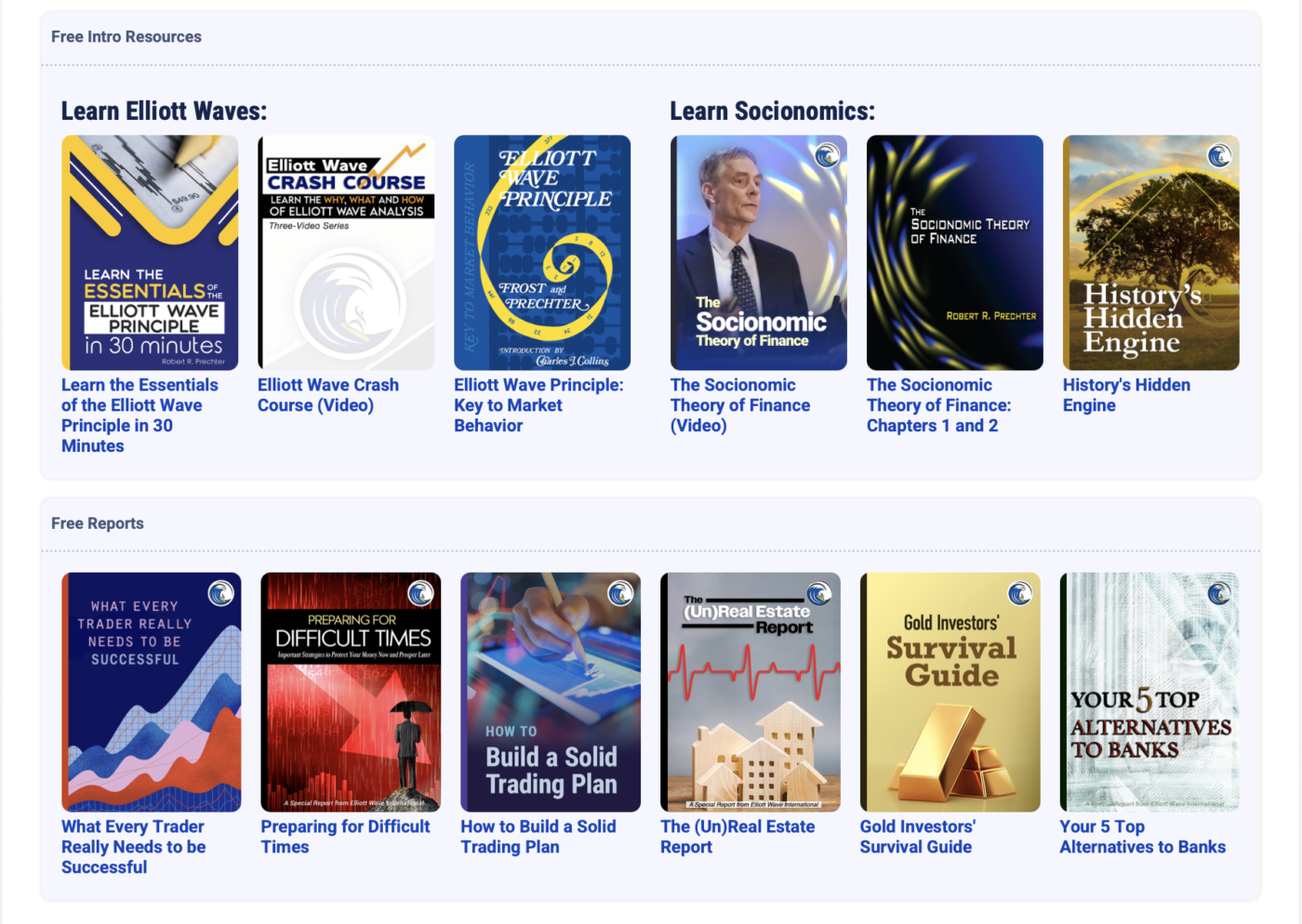
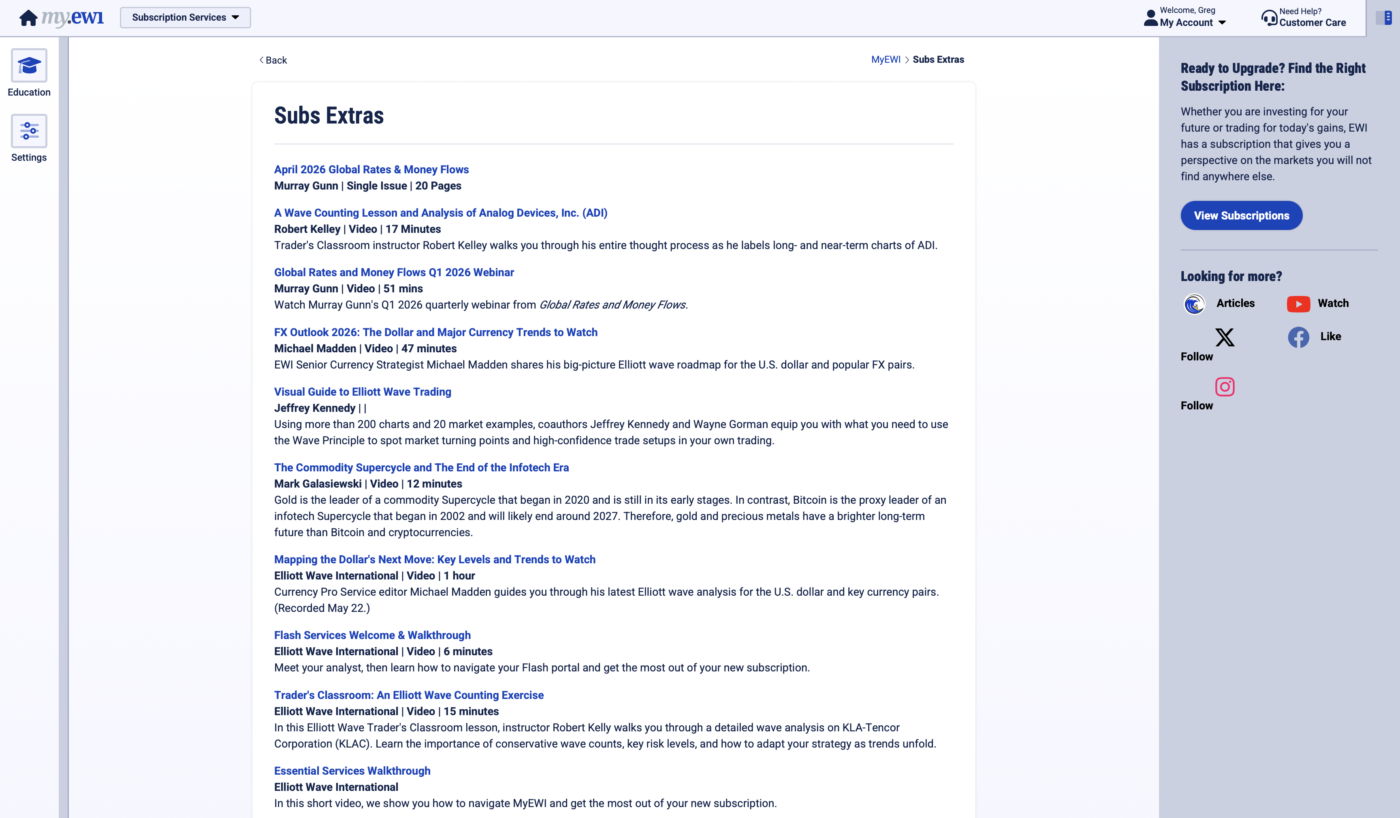
You also get access to “Subscriber Extras” and free educational materials including: books, reports, videos and free or discounted trials of our other services that you may find valuable.
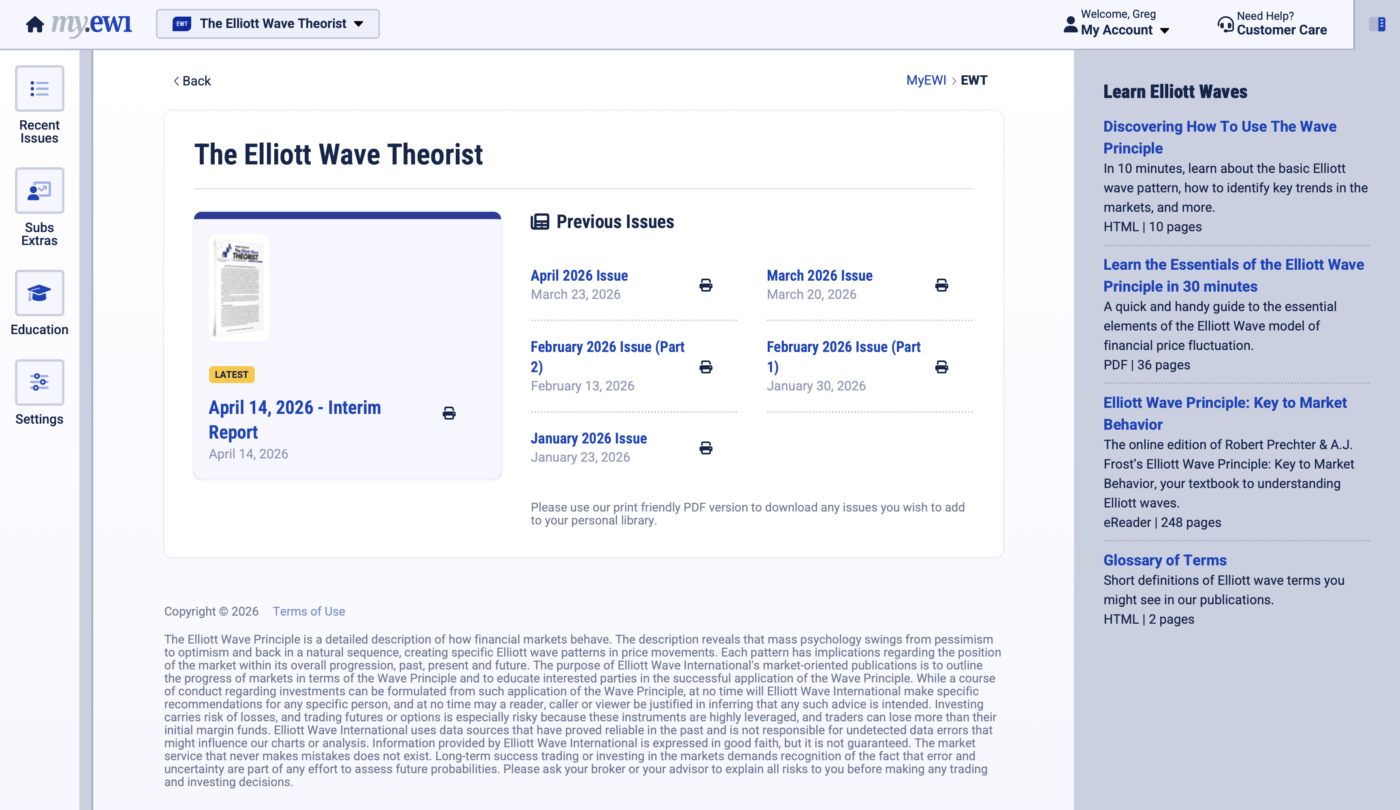
How is Delivered?
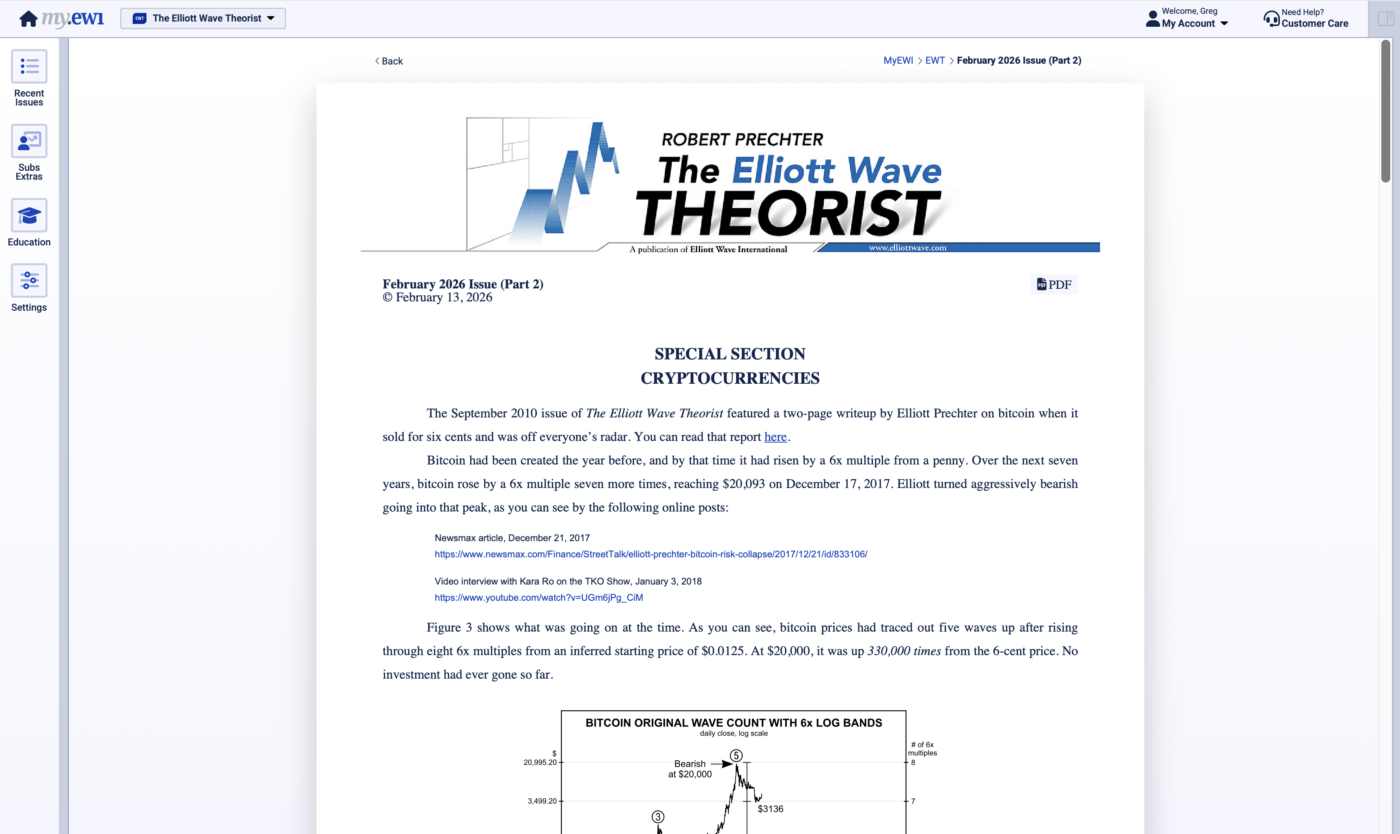
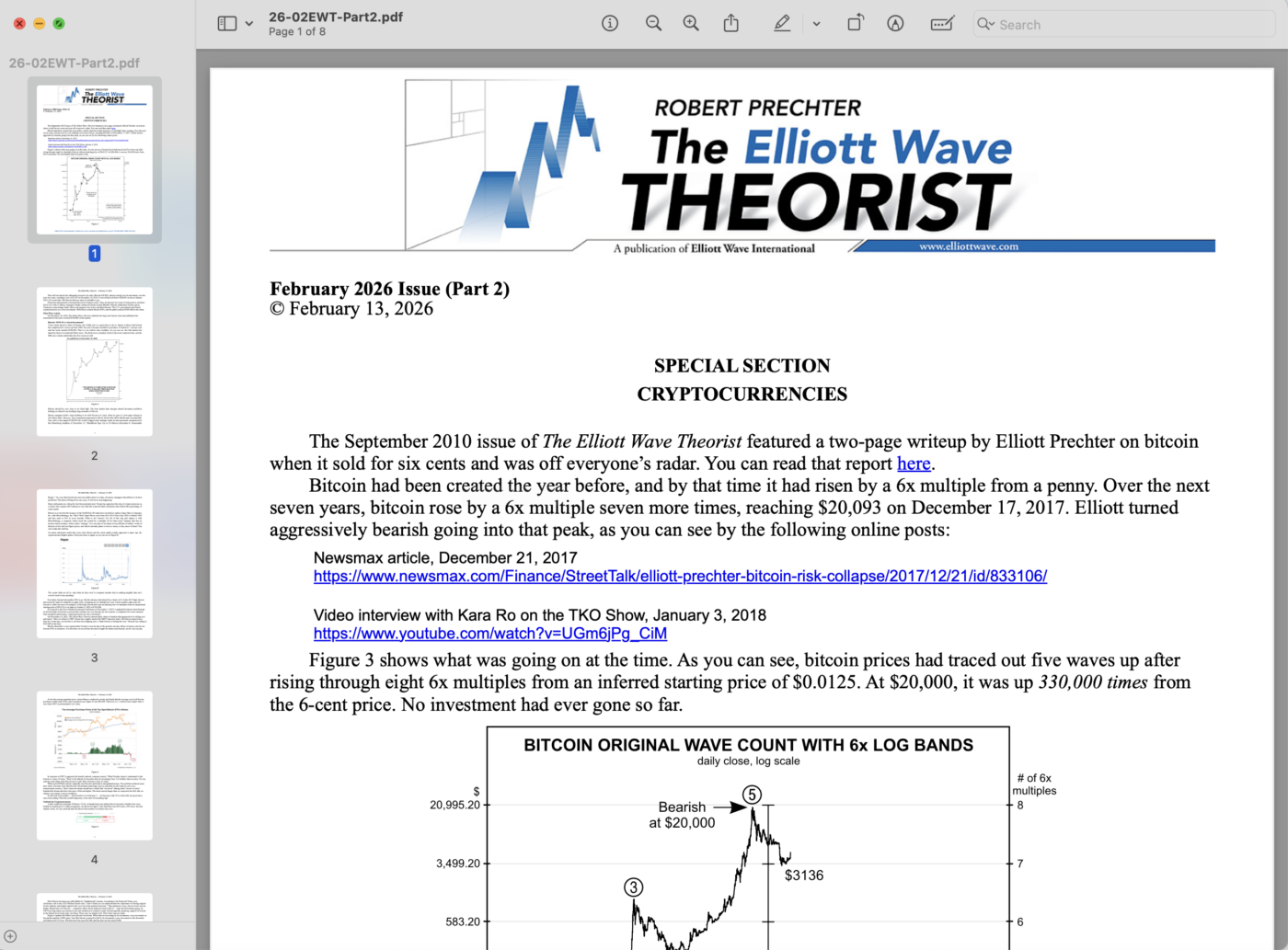
All publications and resources are delivered online through our MyEWI Subscriber Portal. Just sign-in through your computer, phone or tablet for instant access. Here are some photos of what it looks like:

Most Popular – Get ALL 3
(Complete coverage with two monthly publications and market updates 3x a week – every Monday, Wednesday, and Friday)
Choose your billing frequency:
Monthly
$141/mo $97/mo
Annual
$1,692/yr $1,164/yr
(You Save 31%)
(Two essential monthly publications that leapfrog each other throughout the year.)
Choose your billing frequency:
Monthly
$74/mo $57/mo
Annual
$888/yr $684/yr
(You save 23%)
OR: Get Them Individually
 The Elliott Wave Theorist, ($37/mo or $444/yr)
  The Elliott Wave Financial Forecast, ($37/mo or $444/yr)
  Short Term Update, ($67/mo or $804/yr)
 Not ready to subscribe? Try a single issue >>
Order by Phone
Mon-Fri, 8am-5pm Et
Contact us at 800-336-1618 or 770-536-0309 (Internationally) and you will get a fast, friendly, knowledgeable person to assist you.
LIVE CHAT
Mon-Fri, 8am-5pm ET
Please use the LIVE CHAT button at the bottom right of your screen to chat with us.
We accept online payments from Visa, MasterCard, American Express, Discover, and Bitcoin through our online store. We also accept payment via PayPal, money order, bank wire, and check (drawn off a U.S. bank). If you would like to pay by any of these methods, please contact our Customer Care Representatives via phone, email, or live chat to place your order.
EWI’s Research is Trusted by Thousands of Independent Investors and Market Professionals at the World’s Largest Institutions