
Robert R. Prechter is the President and Founder of Elliott Wave International, editor of one of the longest-running financial newsletters in existence today (The Elliott Wave Theorist), author of 18 books on finance including a New York Times bestseller, and pioneer of socionomics.
The editors of The Socionomist asked Bob Prechter to discuss a question many people are asking today:
What’s going on in society such that all three of the Mamdani-backed socialist candidates in the recent NY Democratic primary won?
Prechter explains how shifts in social mood can influence political movements, cultural trends and the rise of competing ideologies.
====
The Socionomist: Bob, years ago you wrote: “In a formalization of the negative mood within a bear market, one or more of the new parties is likely to represent ideals inimical to individual liberty (such as socialist, racist, fascist or fundamentalist).” That’s a remarkable statement. What led you to that conclusion?
Robert Prechter: I noted that such changes tended to occur in bear markets, indicating that they are two manifestations of one thing: a trend toward negative social mood. That’s when society simultaneously values stocks lower and embraces radical political movements.
TS: Why should a trend toward negative social mood have anything to do with that?
Prechter: Negative mood produces pessimism, fear, anger, envy and feelings of righteousness. It’s that simple.
TS: Which movements seem relevant today?
Prechter: All of them. Socialism and communism have become popular. Last night in New York, all three candidates backed by Mayor Zohran Mamdani won Democratic primaries. A few years ago, anti-white racism became institutionalized. Europe has imported fundamentalism in the form of Sharia Law, which is practiced in parts of England. Each U.S. party accuses the other of fascism, so that’s covered, too. One current U.S. senatorial candidate both espouses communism and sports a Nazi concentration-camp tattoo. You didn’t see any of this in 1999, at the peak in positive social mood.
TS: Are these changes good or bad?
Prechter: That is a moral question. Some people are passionately in favor, and some are passionately against.
TS: Your original passage went even further. You added that major parties can suffer “a multi-decade setback, a radical change, or dissolution.”
Prechter: Yes. During periods of strongly negative mood, political parties often fracture, merge, reinvent themselves or disappear altogether. That has been happening to both U.S. political parties. Trump’s vision has taken over the Republican Party, and the Left’s vision has taken over the Democratic Party.
TS: Some of the historical examples you cited are Russia, Germany, China, Cambodia and Iran.
Prechter: Those cultures differed enormously from each other, yet each experienced a period during which established institutions lost legitimacy and extreme political alternatives gained power. The same thing happened in Cuba and Venezuela.
TS: What’s the common thread connecting socialist, fascist and fundamentalist movements? Most people see them as opposing each other.
Prechter: They aren’t much different. The rallying cry may be economic equality, national greatness, racial purity, cultural guilt or religious truth. But they all demand that individuals sacrifice personal liberty for an ideology.
TS: Is the outcome always collectivist?
Prechter: No. The most reliable aspect is that changes will be radical. On rare occasions, negative social mood led to individualist revolutions, such as in the U.S. in 1776 and in Argentina in 2023. The main thing that happens is an overthrow of the old political order.
TS: How long has social mood been trending negative?
Prechter: Since 1999. That’s when stocks topped out when priced in real money, meaning gold. Inflation has hidden the decline in stock prices, which has been quite persistent.
TS: How long will the trend toward radical politics last?
Prechter: The tendency is to last a few years after the trend toward negative social mood reverses. Based on our stock market outlook, that time seems decades away.
====

Subscribe to The Socionomist
Our researchers decode how social mood is reshaping politics, culture, religion and markets, forecasting the trends most people never see coming.
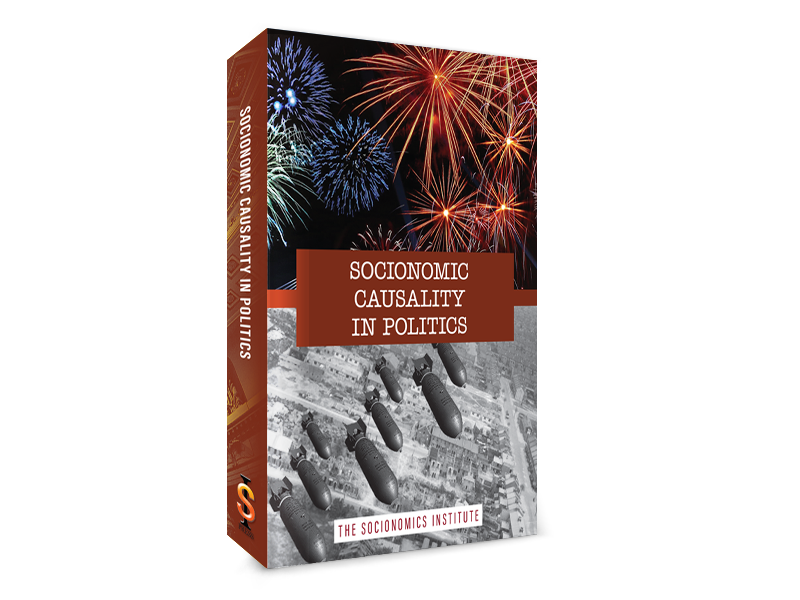
Read Socionomic Causality in Politics
Suppose you had a single framework that enabled you to understand why certain candidates win elections and why nations go to war. And why a country’s internal politics can be peaceful one minute and beset with strikes, protests and terrorism the next. Such is the value of Socionomic Causality in Politics.