Advancing the Study of Social Mood & Action
 The Socionomics Institute
The Socionomics Institute advances the study and application of socionomic theory, helping readers understand how changes in social mood shape trends in financial markets, the economy, politics, business, popular culture and other areas of society.
Through the monthly publicationThe Socionomist, videos, books, research papers and other educational resources, you’ll learn to view the world through a different lens — one that can help you recognize developing opportunities and risks that conventional analysis may overlook.
Memberships & Resources:
- Socionomics Premier Membership
- Monthly Publication – The Socionomist
- Books
- Videos & Presentations
- Papers & More
See the Markets – and Society – Through a Different Lens
Financial markets don’t exist in isolation. Socionomics views them as one of the clearest expressions of social mood — shifts in optimism and pessimism that can also influence trends across business, politics, culture and society.
Understanding those shifts in social mood can enable investors and traders to stay ahead of emerging trends, anticipating developments that may catch others off guard — and better position themselves to seize opportunities and mitigate risks.
View Some Ways Socionomics Can Help You
1. Spot Emerging Opportunities
Changes in social mood can help you recognize shifts in behavior that may eventually create new markets and investment opportunities.
In 2009, for example, The Socionomist anticipated a breakdown in marijuana prohibition. At the time, recreational marijuana wasn’t legal in a single U.S. state. What followed was a dramatic change in public attitudes and legalization — and the emergence of an entirely new legal industry.
2. Identify Risks Others May Not See
Strong business conditions and rising share prices can make it easy to assume more of the same. Socionomics gives you another way to assess when the environment surrounding a company or industry may be changing.
That perspective can help you look beyond today’s revenues, headlines and prevailing sentiment to consider risks that may not yet be reflected in conventional analysis.
3. Recognize Extremes in Market Psychology
Extreme optimism can fuel financial manias, while extreme pessimism can accompany major market lows. Socionomics, together with Elliott wave analysis, can help you recognize when crowd psychology is reaching an extreme — and when that trend may be approaching a turning point.
4. Anticipate What Areas Social Mood Will Affect Next
Some actions express social mood quickly. Others — including economic, political and business decisions — can take longer to develop.
That distinction can be valuable. If financial markets are already reflecting a meaningful change in social mood, Socionomics gives you a framework for considering where the effects of that change could show up next — in regulation, consumer behavior, business conditions and other areas that can matter to investors.
5. Understand What’s Behind the Market Pattern
Elliott wave analysis identifies recurring patterns in financial-market prices. Socionomics provides another dimension: It views those patterns as expressions of changing social mood.
That can give investors and traders a deeper understanding of the psychology behind the market trends they’re seeing.
6. Look at the News Differently
Investors are constantly trying to determine what the latest election, economic report, geopolitical development or breaking headline will do to the markets.
Socionomics starts with a different question: What might the markets already be telling you about the social environment in which those events are unfolding?
That shift in perspective can help you avoid simply reacting to events — and start thinking about the conditions that may be shaping what happens next.
At its core, Socionomics helps you understand the role social mood plays in shaping markets, events and trends throughout society.
By understanding social mood, you can step outside the prevailing crowd psychology, recognize trends others may overlook and make your own decisions with a broader perspective on what may be developing next.
See What Others Say About Socionomics
“It is the key to not only understanding markets, but many other economic, social, cultural and political phenomena.” – P.A.
“I feel extremely prepared and ahead of the curve thanks to your excellent teachings and interpretations of the law of nature. Thinking socionomically has changed my life. Thanks for keeping it real and telling it as the Principle dictates.” – J.M.
“One of the great things about socionomics is it’s not just about money and markets. A grounded knowledge in probabilities allows folks to act and take necessary steps to protect their families, and loved ones before the masses panic.” – T.H.
“Both students and practitioners in financial markets will discover socionomics to be intellectually broadening, financially rewarding and entertaining.” – Henry O. (Hank) Pruden, Professor of Business and Director of the Technical Market Analysis Program, Golden Gate University
“Now when I see things on the news, I am not surprised or emotionally disturbed as much as I was in the past. This education that I have gotten from you has certainly oriented me with the higher laws of the universe. I certainly feel that society and governments would benefit greatly if Socionomics was more widely known. The world NEEDS to know Socionomics!!!!” – Gene F.
“I find it impossible to follow the events of the world without wearing my new socionomic spectacles.” – N.M.
“Outstanding. A profound shift in perspective.” – W.C.
“It’s like looking behind the curtain all of a sudden. I loved it, it helps me understand why the market can be irrational longer than you can remain solvent!”
“Life changes after reading your work. It is amazing how a small change of perspective can result in such a different vision of how the world of humans works. Thank you.” – N.M.
“It truly is a different way to look at the world. I wish I had learned about socionomics when I was 18 instead of 38.” – J.B.
“The observations and conclusions are well thought out and resonate well with me.” – S.M.
“So much about the human experience that had mystified me. Seems so clear now, so understandable, even to the point of being predictable.” – J.H.
“This theory of social mood has grown on me. I now see it almost everywhere.” – N.C.
“You have hit on why mainstream, contemporary economics is not just irrelevant but intellectually void.” – W.P.
“I am about to receive my MBA from a top business school and can say that your work is more interesting, realistic, and useful than anything that I’ve studied to date. Keep up the great work because we are counting on it.” – B.W.
“I have always searched for answers about the nature of things, something that satisfied both my intellect and my sense of wonder. You have advanced my thinking and given me cautionary advice about the road ahead.” – N.M.
“I was instantly intrigued. I almost feel that I have been wasting my time studying other approaches concerning the market and social behavior.” – M.K.
“The two most important forecasts of my lifetime have been provided by the Elliott Wave Principle and socionomics. Finally someone has found the pulse we need to put our finger on.” – E.M.
“Socionomics should be taught in every major university.” – D.L.
“As a psychologist, I’ve been looking for a theory that translates psychological and sociological theory to economics, and I think socionomics is the best idea I’ve come across.” – J.W.
“When the light of understanding hits you, it is powerful. It is so enlightening.” – S.I.
“Thanks for all the amazing work. I feel a little like a member of the team on Mount Olympus.” – M.K.
“I don’t want to be dramatic, but I believe socionomics may have saved us from financial and social peril.” – D.L.
“I have been very impressed with the unique perspectives and insights. I am a Ph.D. student and have studied academic literature, but in all fairness I have not come across anything nearly as insightful.” – D.V.
“Thinking socionomically is so insightful it is almost an unfair advantage.” – E.G.
“Bob and his colleagues at the Socionomics Institute weave together psychology, economics, sociology, linguistics and history to show not only how our mood impacts our actions, but how mood impacts ALL of our actions simultaneously, too. We act as we feel not in just one way but in all ways at once. … While our means of expressing mood may have evolved over time, our underlying behavioral traits never really change.” – Peter Atwater, President, Financial Insyghts; Adjunct Professor, University of Delaware
“I was instantly intrigued. I almost feel that I have been wasting my time studying other approaches concerning the market and social behavior. Keep up the good work.” – Michael K.
“Your lucid writing makes complex subject matter—that most of us would never tackle—downright accessible. Thank you; you make us smarter.” – T.B.
“There is no question in my mind that the contents of these books represent forefront material.” – Daryl A.
“I am very intrigued by the work done at the institute; I think the analysis provided is sound. I spent 20 years in Law Enforcement and earned an MBA along the way. What I saw on the job and what I was taught at school never made things connect the way your work has done. I am currently working my way towards advanced degrees in Industrial and Organizational Psychology and your work is even more valid.” – Charles T.
“You know, when I read your work and try to look at things with a Socionomic perspective, it almost makes today’s headlines like yesterday’s news!” – Don W.
“The most straightforward, unassailable description of how and why things happen is social mood. I would not have understood this without your work, but is still surprises hell out of me that the wonks of the world have every other explanation BUT social mood.” – Rod R.
“Socionomics is the most important development in the social sciences for at least the last 100 years and probably ever.” – Robert R.
“Socionomics has expanded our knowledge of finance by showing that actions based on social mood, fluctuating in accordance with the Elliott Wave Principle, determine prices in financial markets.” – George S.
“In my opinion, the Socionomics model provides a great “reality check” against the “news” and hype that spins out from our televisions, computers, radios and rumor. While I may not always use this model in the best or most orthodox manner, I regard it as a must-have tool in my toolbox when planning or pondering the future.” – Michael F.
“It is a scholarly work of the highest order. Beyond the excellent writing, charts, and format is the fact that data supports the content. I read it with pure delight and feel that tingling “yes!” response in my cells. How good it feels to read truth.” – Caren C. Bethesda, Maryland
What do I get with a Subscription/Membership?
Subscribers to The Socionomist monthly publication:
You get immediate access to the latest issue and 100+ issue archive, so you can get up to speed quickly. From there, we’ll notify you whenever we publish a new issue.
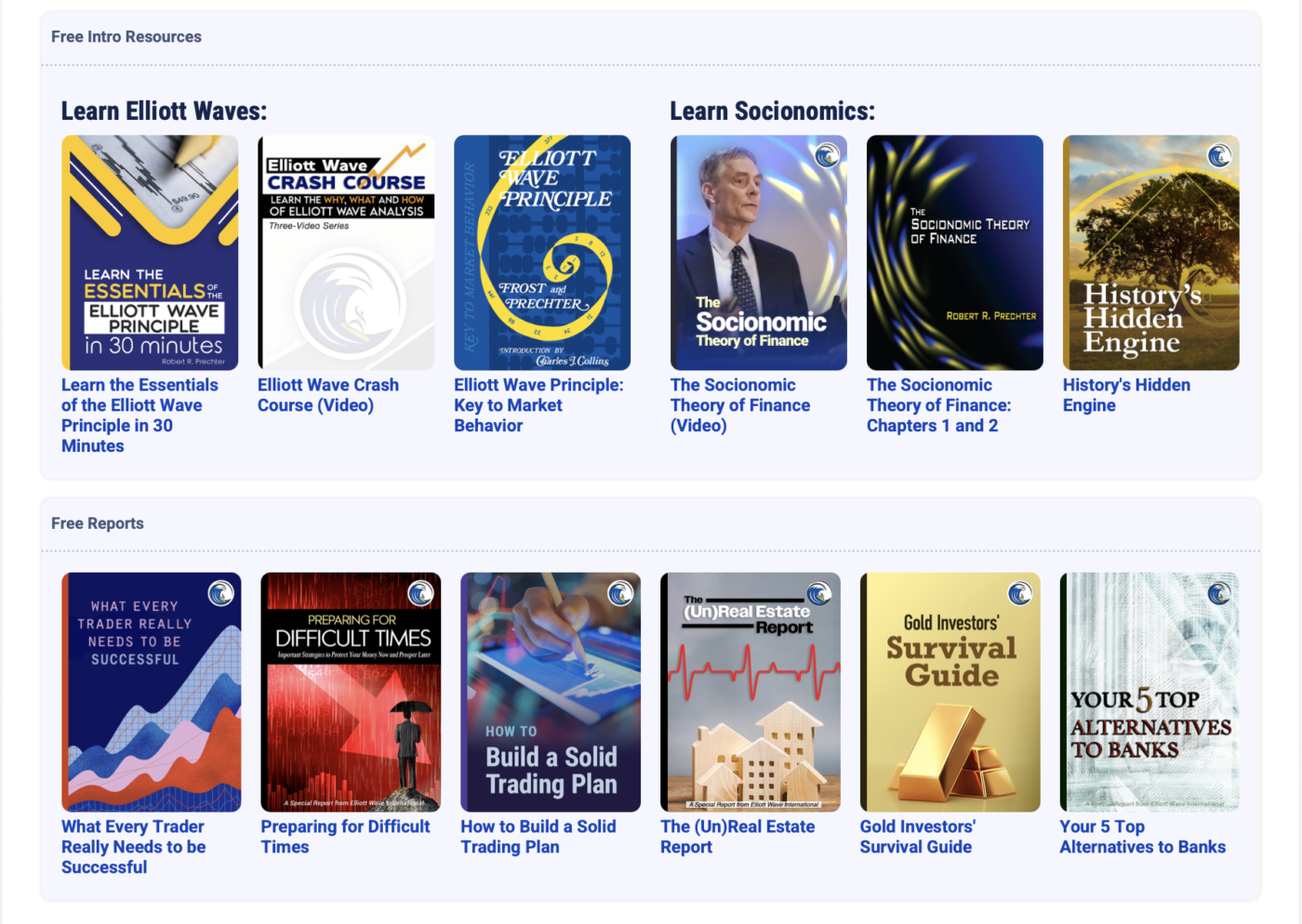
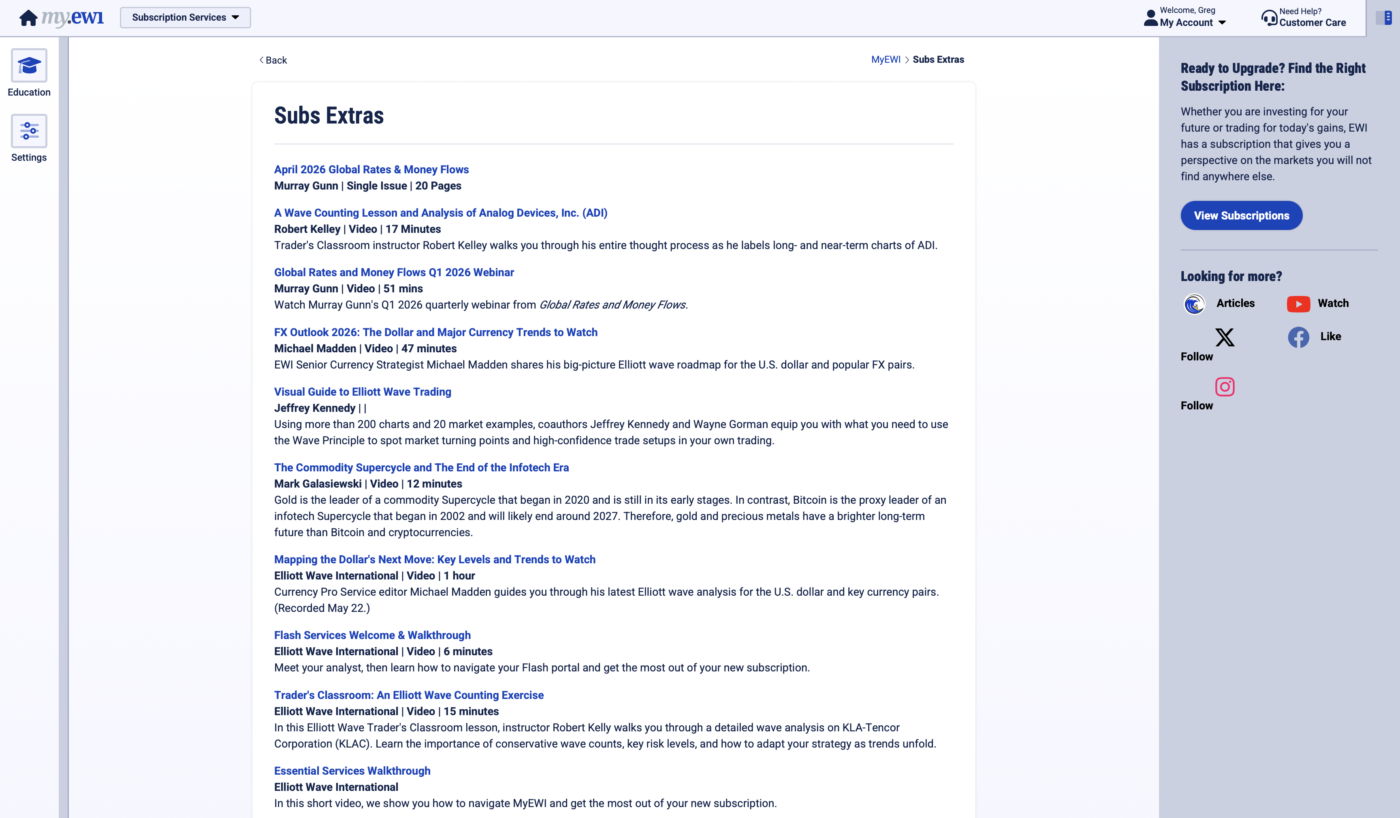
You also get access to “Subscriber Extras” and free educational materials including: books, reports, videos and free or discounted trials of our other services from Elliott Wave International that you may find valuable.
Socionomics Premier Membership:
You get immediate access to ALL socionomic resources including:
✅ The Socionomist every month
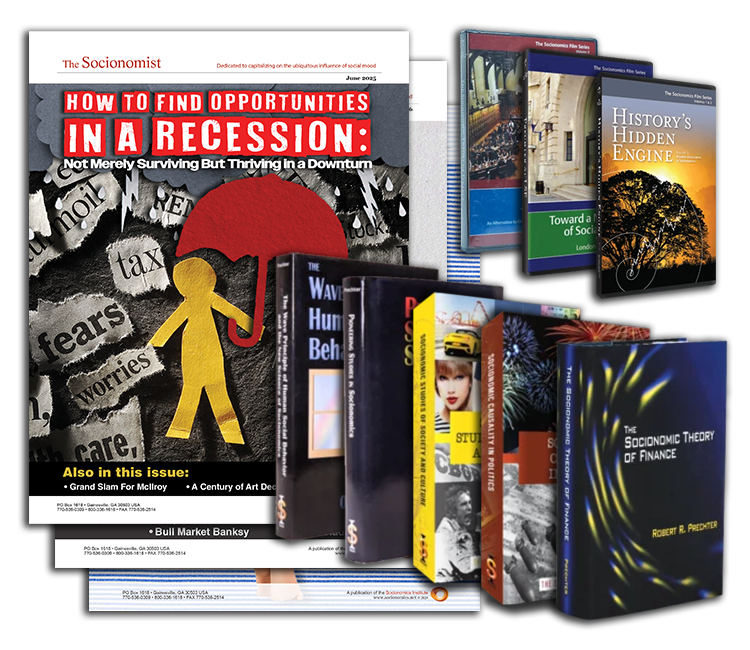
✅ The entire Socionomics Digital Books Collection: The Socionomic Theory of Finance, The Wave Principle of Human Social Behavior, Pioneering Studies in Socionomics, Socionomic Studies of Society and Culture, and Socionomic Causality in Politics
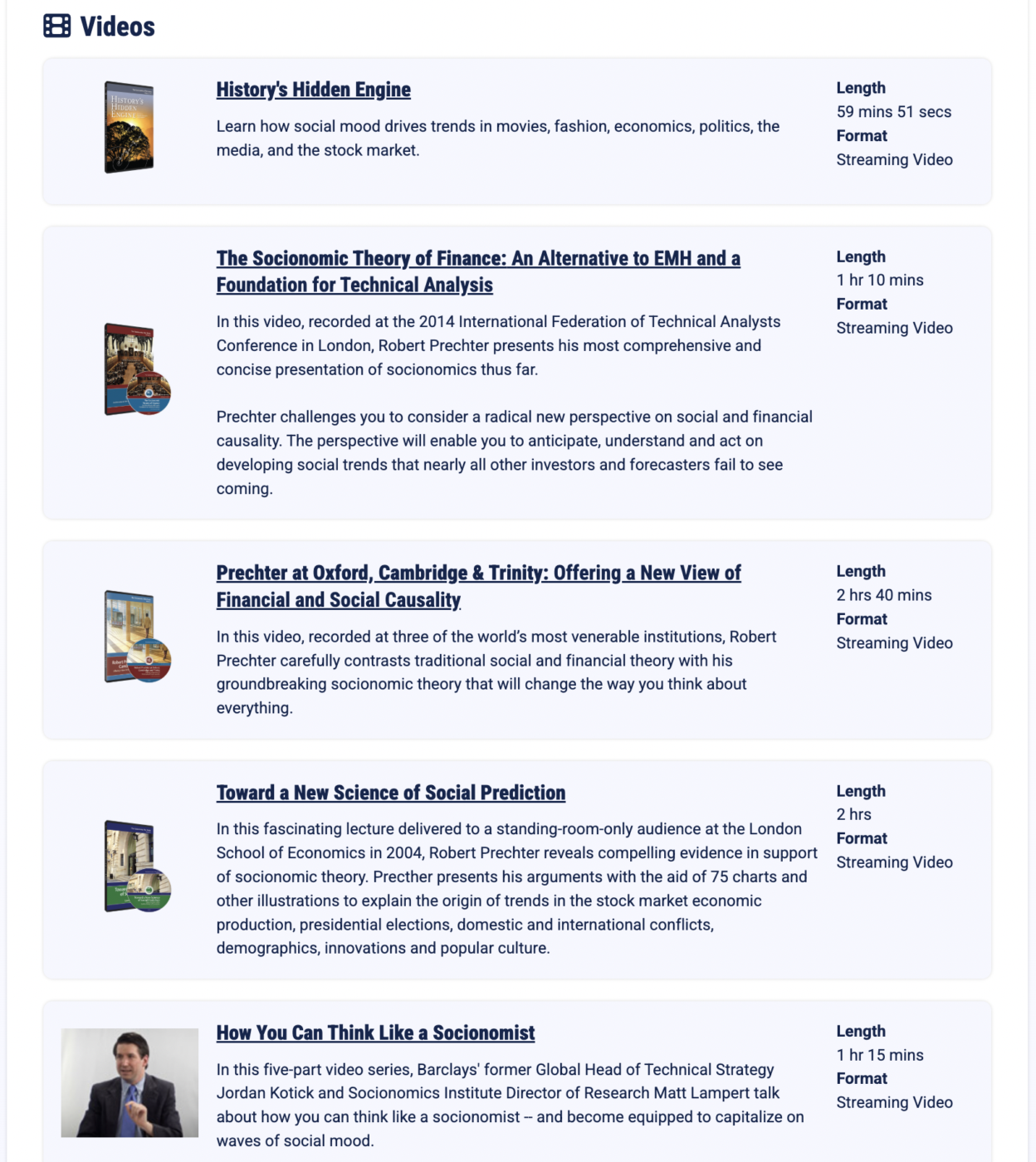
✅The Socionomics Film Series: History’s Hidden Engine, The Socionomic Theory of Finance: An Alternative to EMH and a Foundation for Technical Analysis, Prechter at Oxford, Cambridge & Trinity, Toward a New Science of Social Prediction: Robert Prechter Speaks at the London School of Economics
✅ The Social Mood Conference Videos (2011-2016)
✅ Access to our catalog of exclusive videos, research papers, presentations, and more.
✅ Other “Subscriber Extras” and free educational materials: books, reports, videos and free or discounted trials of our other services from Elliott Wave International that you may find valuable.
How is it delivered?
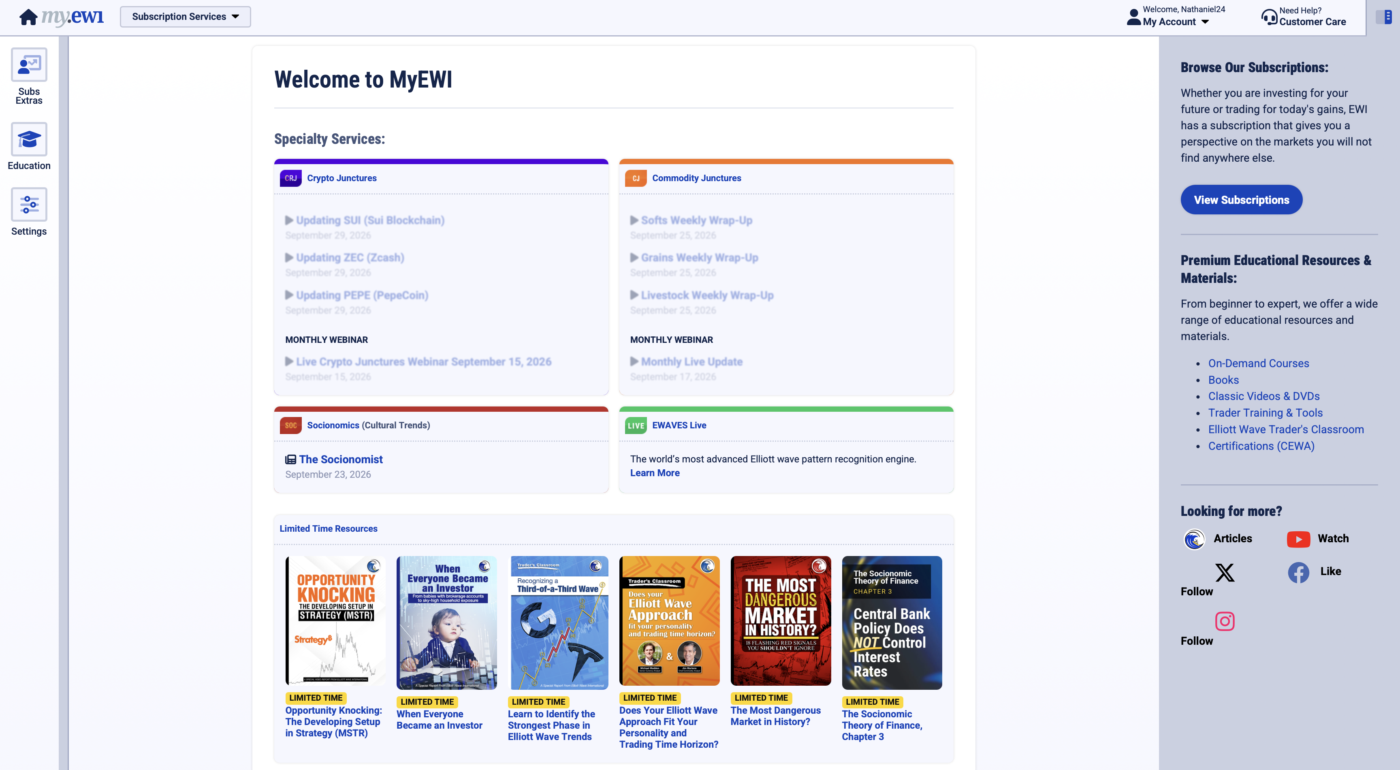
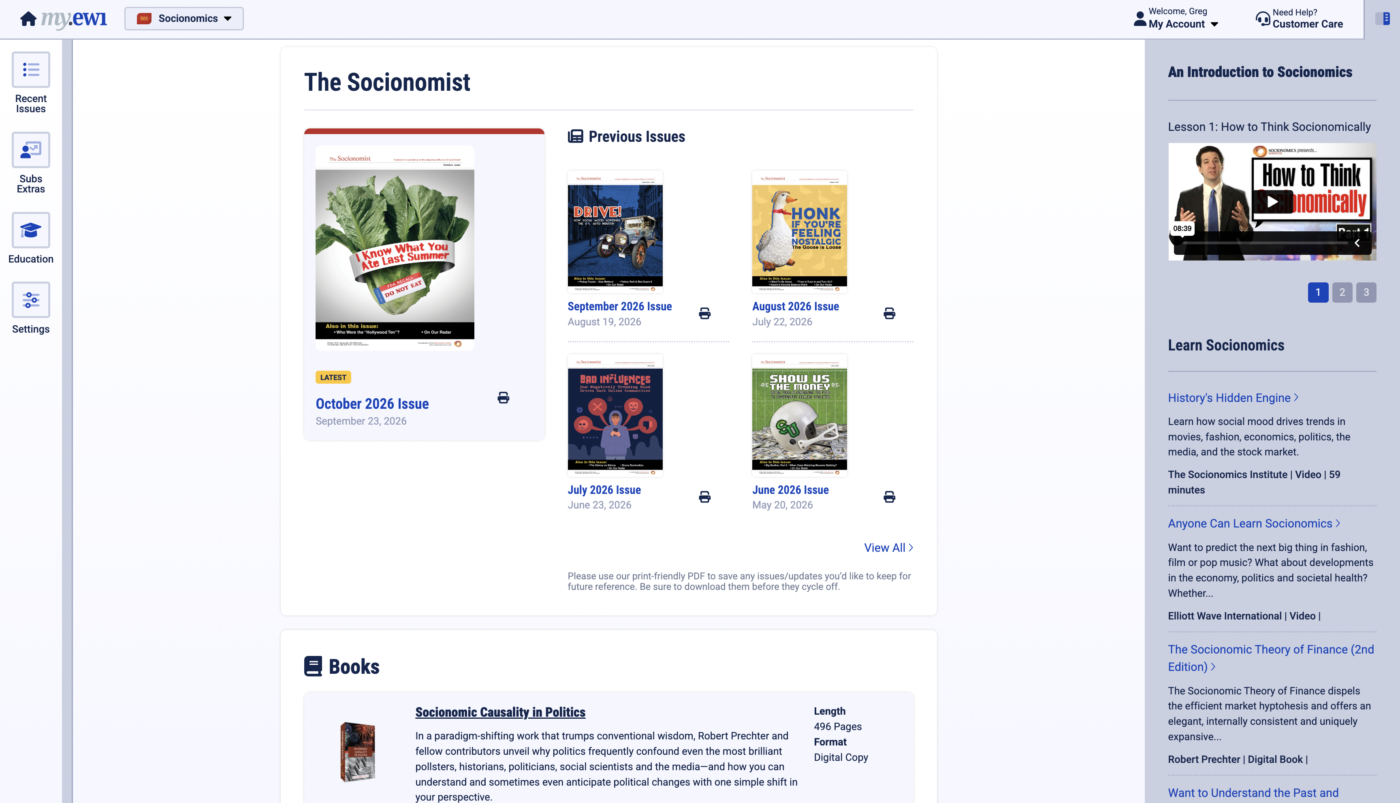
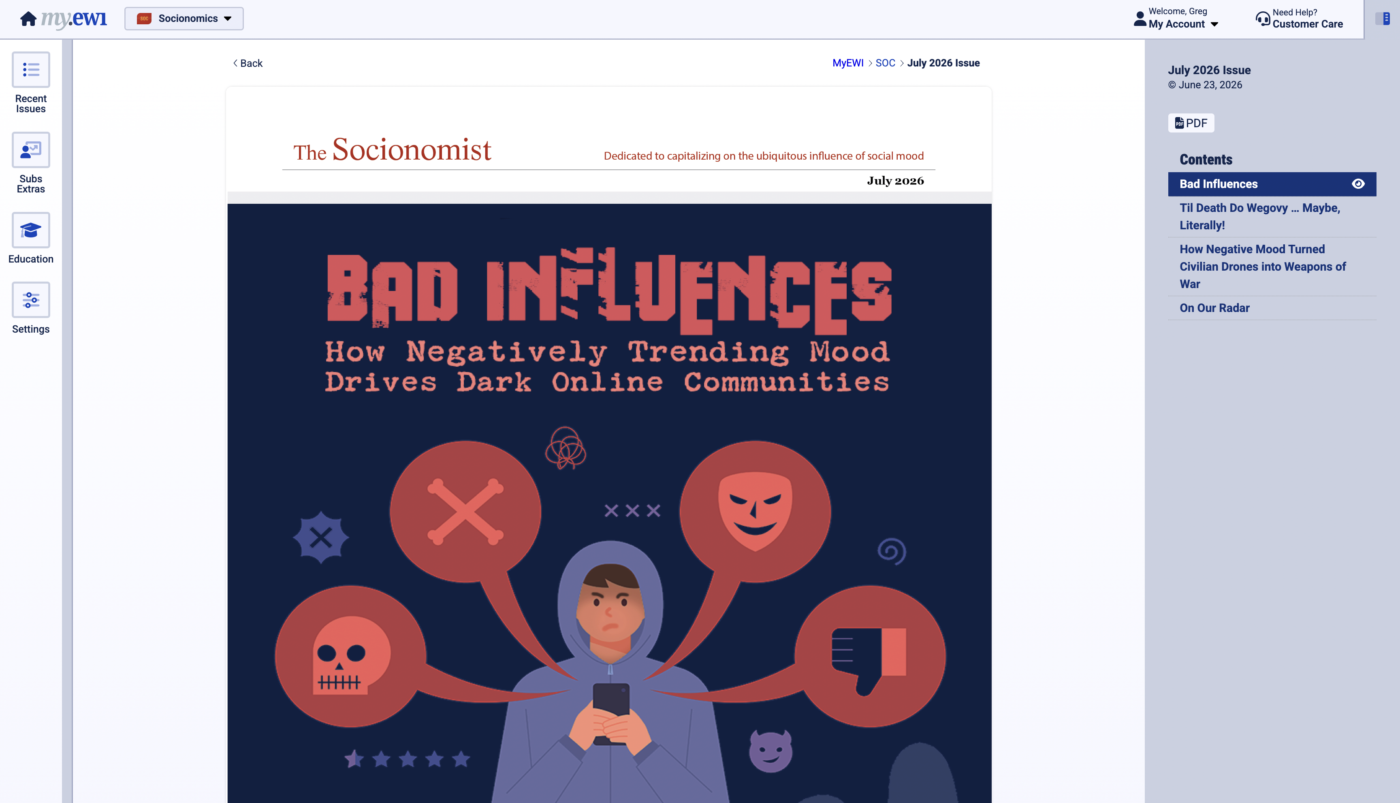
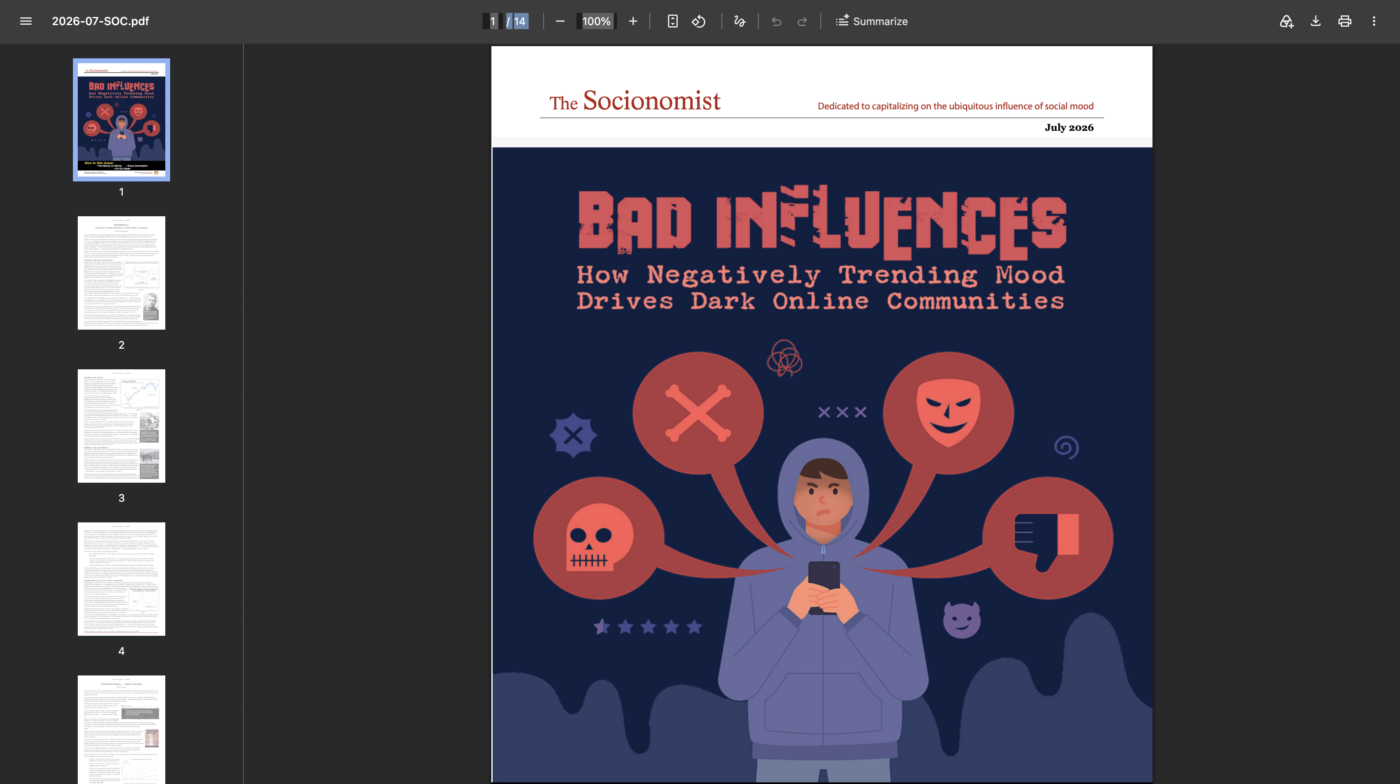
All publications and resources are delivered online through our MyEWI Subscriber Portal. Just sign-in through your computer, phone or tablet for instant access. Here are some photos of what it looks like:

View Some Notable Socionomic Highlights
This collection of essays from The Socionomist research library underscores the ability of socionomics to anticipate the timing and magnitude of social, political and moral trend changes, including the Covid pandemic, increased polarization, pro-pot legislation, the rise of authoritarianism – and more! Take a look:
Authoritarianism Across the Globe
Figure 2 shows that over the past 300 years, major bear markets hosted most of the notable examples of authoritarianism. There are incidents of authoritarianism in bull markets, but they are fewer and smaller.
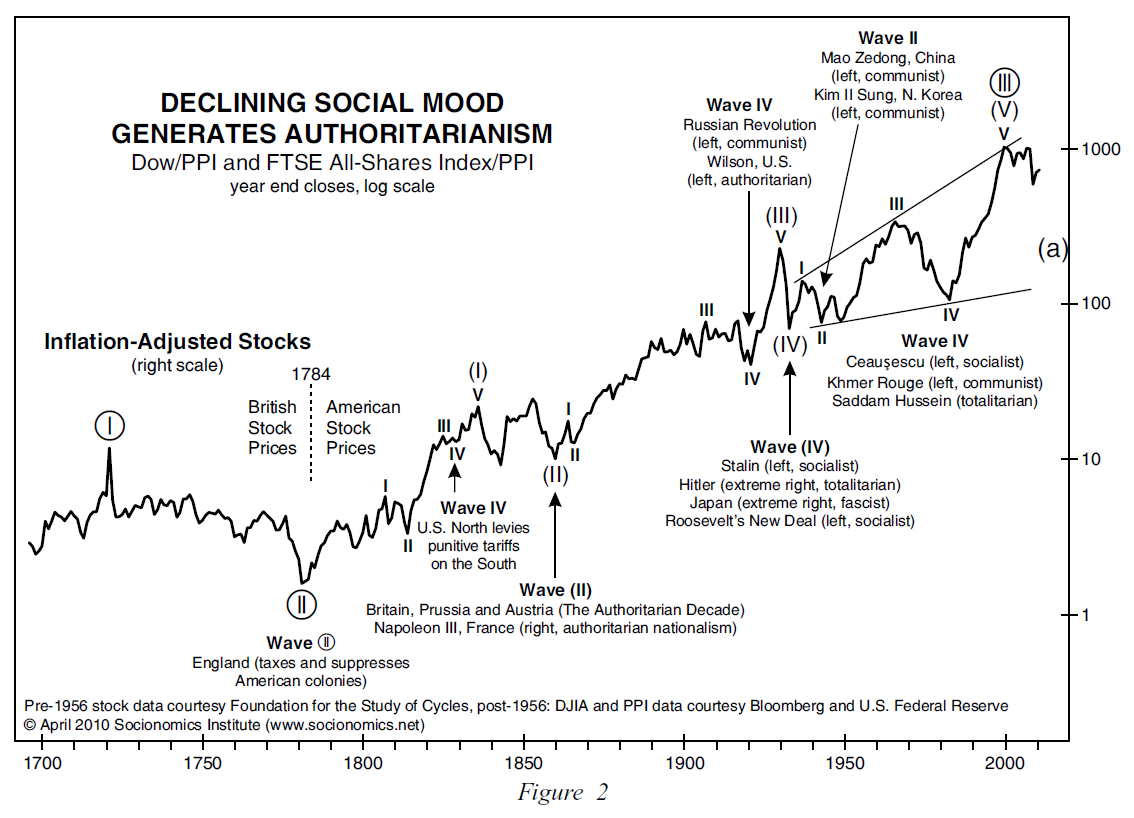
Another bear market began in 2000, and authoritarianism is waxing along with it.
Liberal democracies, which feature constitutional protections of individual rights from government power, have risen in concert with the Dow Jones Industrial Average since the early 1800s. That trend appears to be faltering. Figure 3 is from the February 2010 issue of The Elliott Wave Financial Forecast (EWFF), which observed:
Just as stocks struggled higher in the 2000s, the number of liberated democracies slowed dramatically. A slight tick down, from 90 to 89 “free” countries in 2009, confirms what we said here last month: The social effects of the bear market are mostly still to come. … According to Freedom House, 2009 was “marked by intensified repression against human defenders and activists in 40 countries.” It was the fourth straight year of increased repression, “the longest stretch of civil rights setbacks” in 40 years.
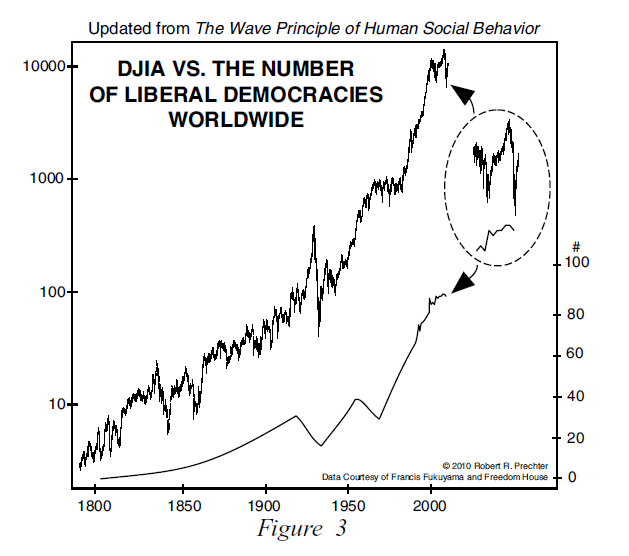
Freedom House is an international organization that researches and advocates democracy, political freedom and human rights. Its director of research, Arch Puddington, wrote “Civil Society Under Threat,” published in the spring 2009 issue of Harvard International Review. It begins with this warning:
After several decades of consistent progress, the state of global freedom has entered a period of stagnation and possibly even decline. Among the principal targets of the new authoritarianism is civil society. The result has been a notable reversal for freedom of association throughout much of the world.
After a long trend toward positive social mood, authoritarianism’s popularity hit bottom in the 1990s, when the Soviet Union collapsed and political scientist Francis Fukuyama proclaimed, “the universalization of Western liberal democracy as the final form of human government.” Now, just a decade later, authoritarianism is resurgent.
Socionomics suggests that today’s expressions of authoritarianism are occurring at the beginning of a much larger trend.
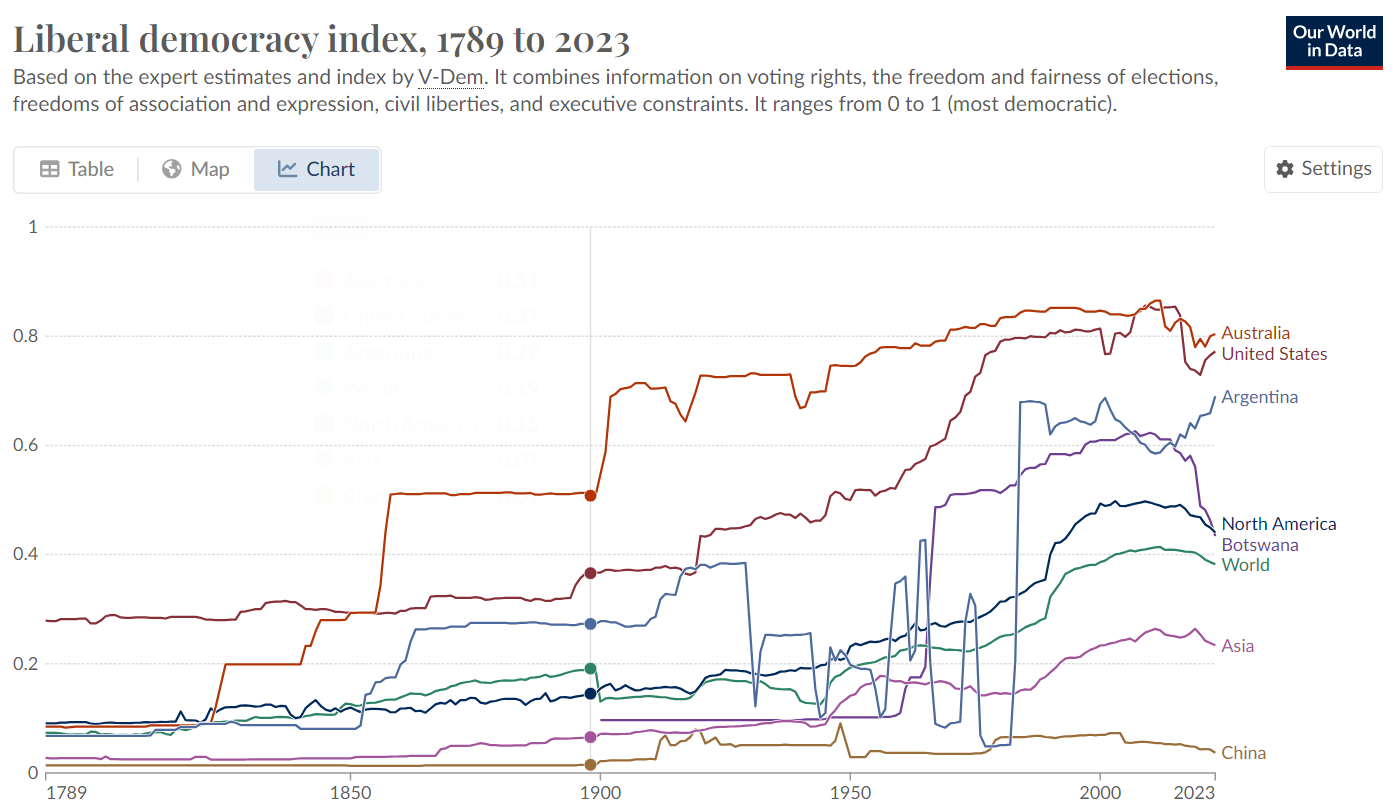
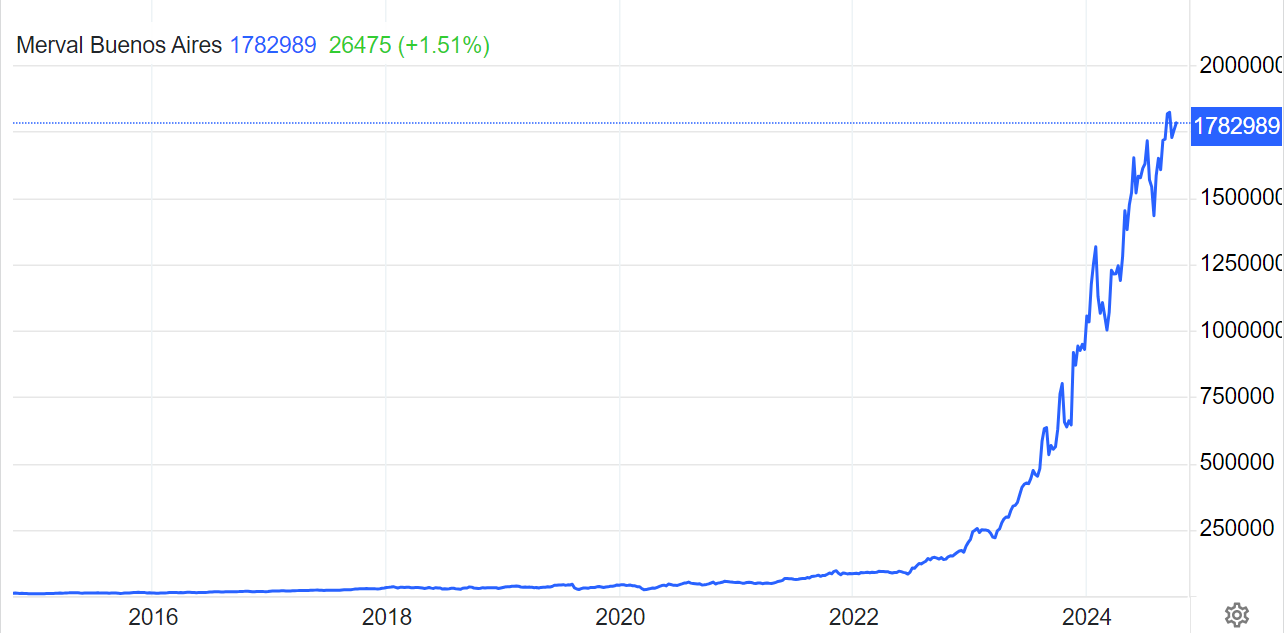
[Editor’s Note: March 9, 2023 Freedom House: “Global freedom declined for the 17th straight consecutive year as 35 countries suffered deterioration in their political rights and civil liberties, according to a new report released today.”
Updated chart of Liberal Democracies Worldwide shows a widespread decline but for one outlier Argentina, reflective of the country’s parabolic market rally]
[Editor’s Note: “The Authoritarian Strongman Government Is on the Rise” April 29, 2024 Internationale Politik Quarterly reports on the rise of autocratic leadership across the globe.]

May 2010:
Based on the evolution of authoritarian regimes in the past and what we observe in society today, it is logical to expect the progression from social fear to authoritarianism to unfold in roughly the following fashion:
A general bearish fear of the future causes people to coalesce into groups with polarized views on the authoritarian/anti-authoritarian issue. These disparate groups exclude all messages that contradict their opinions. Cass R. Sunstein, in a 2001 essay in The Boston Review, notes the growing power of information consumers to “filter” what they read or see. He writes, “insulation from alternate views breeds increasing extremism.” Socionomists, however, would say increasing extremism breeds insulation from alternate views. Aspiring authoritarian and anti-authoritarian leaders alike use exclusionary propaganda to leverage this tendency. Leaders encourage their groups to see other groups as threats; actions escalate in a quid pro quo.
If a negative trend in social mood is large enough, blatantly authoritarian leaders emerge and promise security. They attract support as well as strident opposition. In most cases, we can’t say which side will ultimately prevail.
Here are several specific forecasts and examples that typify the authoritarian trend generated by the deepening bear in mood:
GOVERNMENTS WILL SHUT DOWN SECTIONS OF THE INTERNET
Paranoid governments have plenty to worry about. Once such incendiary content is on the Web, other sites mirror it almost immediately, thwarting governments’ abilities to force the material back into secret. The days of unrestricted whistleblowers on the Web are numbered.
[Editor’s Note: University of Michigan News, Nov. 17, 2020: “‘Extremely aggressive’ internet censorship spreads in the world’s democracies.” A University of Michigan team used Censored Planet, an automated censorship tracking system launched in 2018 by assistant professor of electrical engineering and computer science Roya Ensafi, to collect more than 21 billion measurements over 20 months in 221 countries
Ensafi’s team found that censorship is increasing in 103 of the countries studied, including unexpected places like Norway, Japan, Italy, India, Israel and Poland—countries which the paper notes are rated as some of the freest in the world by advocacy group Freedom House.]
RELIANCE ON INDEBTED GOVERNMENTS WILL BECOME A FLASHPOINT IN THE AUTHORITARIAN DEBATE
The idea is for the government to take your retirement savings in return for a promise to pay you some monthly benefit in your retirement years. They will tell you that you are ‘investing’ your money in U.S. Treasury bonds. But they will use your money immediately to pay for their unprecedented trillion-dollar budget deficits.
[Editor’s Note: In 2024, a swath of countries, from the UK, Japan, South Africa and Nigeria are moving to tap their nations’ pension funds as economic jumper cables. In Jan. 2023, the U.S. implemented this tactic as well:
Bloomberg, Jan. 19: “Treasury Department is beginning to use…extraordinary measures to avoid the government running out cash. After the debt limit is increased, [the tapped funds] will be made whole with participants unaffected.”]
AUTHORITARIANS WILL CONTINUE TO USE THE FEAR OF TERRORISM TO INSTITUTIONALIZE A CULTURE OF SURVEILLANCE AND CONTROL
[Editor’s Note: In 2012 and 2017, U.S. Congress re-authorized the Foreign Intelligence Surveillance Act (FISA) Section 702, which allows the US government to spy on the internet and telephone communications of people both in the U.S. and abroad without a warrant so long as a “significant” purpose of the surveillance is to gather “foreign intelligence information.” In April 2024, the Senate not only re-authorized the bill, but “dramatically expanded” its power.]
Russia: From Bull Market to Global
November 2007 “Socionomic Study of Russia: Sizing Up a Superpower” Part 1
Still Bullish, for Now
In a radical departure from much of its history, Russia today enjoys a powerful bull market in social mood. The Elliott Wave Theorist first noticed this germinating vibe in the August 1987 issue:
The most important popular cultural event is occurring not in the U.S., but in Russia. Glasnost may have bitten off more than it can chew. Allowing private taxis and tailors is one thing. But now that the Soviets have let rock ‘n’ roll get a foot in the door [allowing a concert of U.S. pop music in Moscow], there will be no easy turning back from the desire for greater knowledge of the tempting joys of the freedom-loving West. (The Elliott Wave Theorist, August 1987.)
Twenty years later, confidence radiates from the russian economy, politics, international relations and the military. As for its stock market, the past decade has seen a sixty-fold increase in the russian Trading System Index. Russians are also embracing debt as never before.
Today: The Power of the Russian Bull
You get a feel for the power of Russia’s positive mood today when you consider that Vladimir Putin’s presidential approval rating is nearly 80%. “In contrast to his predecessor, Boris Yeltsin, notorious for drunken antics, Putin has established an image as serious, energetic, sober and sharp-witted.” (Associated Press) The russian media “can’t get enough of him,” and children wear photos of his face on t-shirts. His recent bare-chested photos while fishing in Siberia were prominently posted on the presidential Web site. “Komsomolskaya Pravda reported that women who visited its Web site posted comments on Putin’s ‘vigorous torso’ and said they ‘were screaming with delight and showering (him) with compliments.’” (AP)
Russia is flexing economic muscle as well. 1992 was the first year that Russia’s GDP was calculated. It weighed in at less than $90 billion. Last year it approached $1 trillion. From 1998 to 2006, Russia’s economy grew 6.7 percent annually. It maintained that rate in 2006 while Germany’s economy grew 2.7%, the U.K. 2.8%, France 2.2% and the Netherlands 3%. (CIA World Factbook.) Russia was finally, for the first time ever, outperforming its European neighbors in a bull market. In Eurasia, only China, with its 10.7% annual growth, was more impressive.
Russia’s federal budget has run surpluses since 2001. In fact it ended 2006 with a surplus equal to 9% of GDP. Since 1999, Russia has increased its foreign reserves from $12 billion to $420 billion, the third largest in the world. The structured finance market is booming in Russia and could hit $5 billion in value this year, according to Moody’s Investors Service. As liquidity flows in, Russians are embracing debt, and household consumption and investment are rising. Loans to individuals rose by 75% in 2006. Outstanding mortgage loans in Russia rose more than 460% since the first quarter of 2006
Bullish social mood is a powerful engine. It created a market economy in Russia and transformed a feeble new democracy into a global player.
Looking Ahead
Our analysis shows the RTSI near the end of a five-wave advance of at least Primary degree. (The chart will follow in part II of this study) For now, recall the description of the personality of a third wave found in Elliott Wave Principle.
From 1998 to date, Russia’s RTSI has increased 7000 percent. Our wave count shows it to be near the end of a five-wave advance of at least Primary degree. Social observations bear this out, as Russia possesses national assertiveness and waxing machismo befitting an approaching top of major significance.
December 2007 “Socionomic Study of Russia: Sizing Up a Superpower” Part 2
Figure 4 below is a chart of the Russian Trading System Index from its inception. Our Elliott wave count in the RTSI shows that a clear five-wave advance beginning in 1999 is near completion. During this time, the RTSI increased by sixty-fold. This index should soon begin its biggest bear market since the five-wave pattern began. The minimum probable drop — a move into the area of the fourth wave of 2004 — would more than halve the value of the index.
Such a decline should produce financial and social events of a character comparable to those seen during comparable declines in the past. Viewed in the context of russian history, this outlook has serious geostrategic implications.
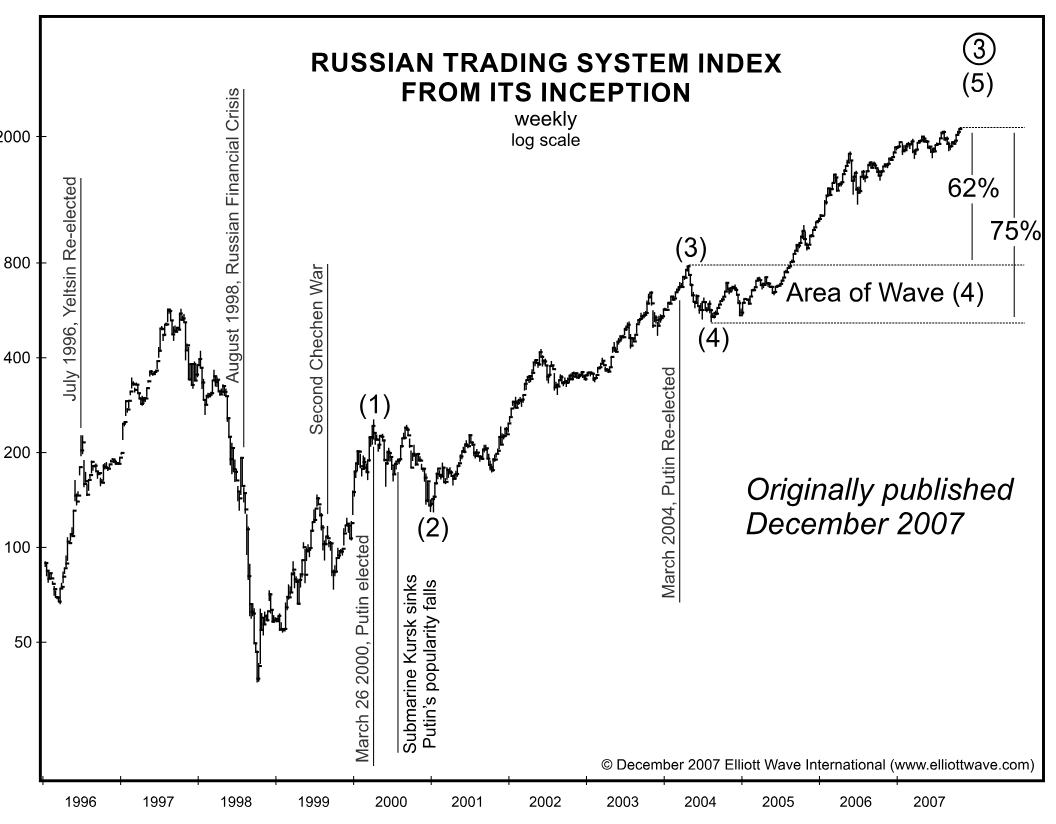
Recent events do seem to foreshadow the expected social character of the ensuing contraction. They suggest that the onset of a bear market in russia should be taken very seriously.
Social mood change at large-degree turns is not instantaneous. It can seem broad and slow as it develops. At peaks, the crosscurrents of changing mood can produce events that signal which entities will act most strongly in accordance with the coming mood shift. The stage is set for a complete return to autocracy.
This situation indicates the re-emergence of a ruling class and perhaps new dictatorship in russia. Putin’s power now is nearly absolute, and he probably won’t relinquish it.
Putin could end up as a powerful prime minister directing a weak president, or, if the United russia party retains a two-thirds majority in the State Duma, it can change the constitution to allow him to return to the presidency. History gives examples of how russian leaders behave in bear markets. It is not a heartening record.
Russia’s long history of border wars and its desire to reclaim the resources of satellite states lost upon the collapse of the U.S.S.R. make future border conflicts likely. The ethnic diversity within these states represents conflicts-in-waiting for the xenophobia that attends bear markets.
[Editor’s Note: RTSI peaked in 2008 and plummeted 85% into 2009 before regaining its footing albeit wobbly. In February 2014, Ukraine’s Revolution of Dignity sparked Russia’s occupation of Crimea from Ukraine and the Russo-Ukrainian War]
March 2014 Socionomist:
Geography is the major subplot in this profoundly unstable mix. EU economic partnerships already include former Eastern Bloc states such as Poland and Romania—now the European Union wants to extend partnerships not only to Ukraine but also to five other states (such as Belarus and Georgia) that were territories of the old Soviet Union. For Russia this would be a loss of economic influence across its entire western border.
[Editor’s Note: In January 2020 Putin announced his intention to modify the Russian constitution in a way that would scrap term limits for presidents, paving the way for him to remain in office indefinitely.]
May 2021 Socionomist:
It is a good time to check on Russia for three reasons. First, Russia remains a major player on the world stage. Back in 1991, with the fall of the Soviet Union, American pundits and political strategists celebrated the downfall of one of the United States’ chief rivals. But as subsequent events have shown, Russia isn’t going anywhere, and the country’s mood-motivated actions continue to have a significant bearing on geopolitics. Relatedly, the tone of Russia’s foreign relations and its domestic affairs signal that the country’s negative mood is again generating dramatic consequences for the nation, its neighbors and others around the globe.
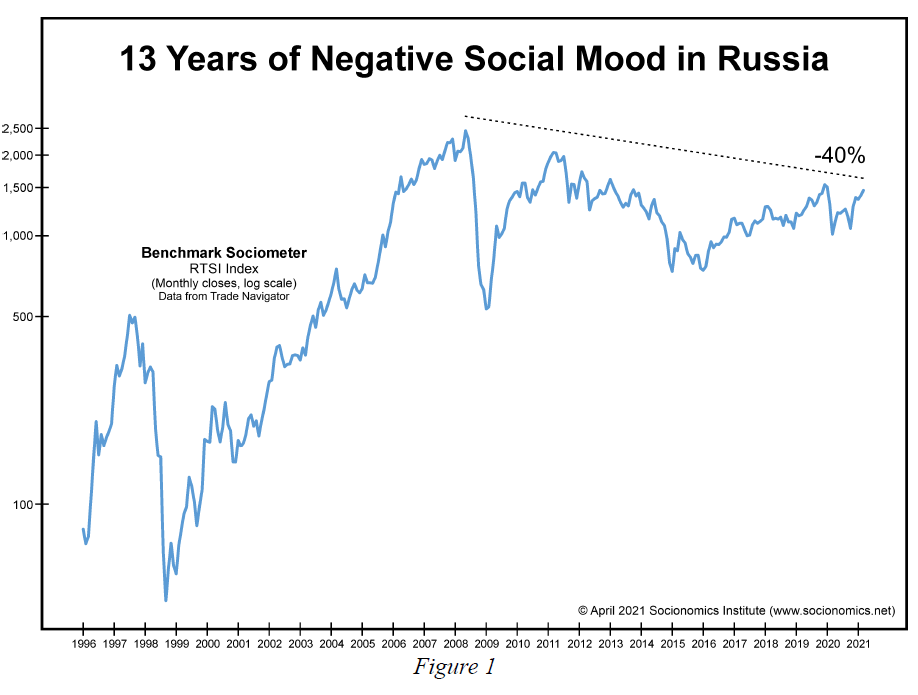
[Editor’s Note: Since its 2008 peak, the RTSI has been mired in a bear market.]
January 2022 Socionomist:
News reports indicate that Putin has now withdrawn approximately 10,000 of the “70,000 to 100,000 Russian troops believed to be stationed near the border.” (NPR) Yet as long as Russia’s bear market persists, conflict risk will remain. Watch the direction of the RTSI for clues about how Russia’s stance is likely to progress from here.
[Editor’s Note: The RTSI rallied into October 2021 to its highest level in a decade, stopped and plunged by more than half into 2024, continuing to reflect the sustained erosion of social mood.
On Feb. 24, 2022, Russia invades Ukraine in the most aggressive phase of the 8-year long Russo-Ukrainian war.
In June 2024, Putin Russia adopted a list of “enemy countries” which the whole of the EU and the U.S. is included. From United24media: “This marks the first official instance of the US being designated an ‘enemy’ state by the Russian government… in an unprecedented and stark escalation from previous rhetoric.]
Polarization Inc.: The Disunited States of America
August 2001:
In a bull market people tend toward consensus, and everybody more or less agrees. Usually that begets a middle-of-the-road psychology. In a bear market you get polarization. On one side you get the people who want to militarize the entire world and on the other side you get people who want to rid themselves completely of state intervention. Usually the forces of centralization and statism win. That occurred in 1917 in Russia, in the 1930s when Hitler took over in Germany, in 1949 when the Communists took China, and in Cambodia in the 1970s. But there are rare times that the bear market ends with the other side winning. The American Revolution is probably the best example. That occurred right into the bottom of a 64-year bear market that we can trace in English stock prices. That was a bear market for England, and they ended up losing the continent, but it was a victory for the freedom side of the polarity. The tensions leading up to the Civil War were also secessionist, but in that case, as more commonly occurs, the centralizers won.
[Predictions for the years, decades ahead as negative social mood accelerates …]
We’re going to polarise. We will have the fascist-communist forces that we’ve already seen hints of in the last 10 years. We’ve got them in our government already. They’re just dying to militarize and control everything, from medicine to banking. On the other side, you’ve got people who are re-publishing the great works of freedom, saying, in effect, “Hey! Do you remember what we had 100 years ago, 150 years ago?” Given the polarization that I expect, the question becomes, which side will win? Frankly, my initial response is, I don’t know and we’ll have to find out. If I were forced to take my best guess, I would have to say that it’s more likely that the forces of control will win, for two reasons. First, that’s the general drift since the founding of the country and is usually the general drift from the founding of any free society. Look at Rome, England, or any of the European countries that were leaders of the world for a while. They’re all tied up in red tape and socialism now. A second reason is, as I said, we’re entering a Grand Supercycle bear market. The last one (in the 1700s) lasted 64 years. This one, by alternation, should last a lot longer and be a sidewise formation in stock prices.
May 2009 Socionomist:
During times when the trend is toward increasingly negative social mood, there is a greater propensity for discord, as Prechter explained in Pioneering Studies in Socionomics:
[A] negative social psychology will be characterized primarily by polarization between and among various perceived groups, whether political, ideological, religious, geographical, racial or economic. The result will be a net trend toward anger, fear, intolerance, disagreement and exclusion, as opposed to the bull market years, whose net trend has been toward benevolence, confidence, tolerance, agreement and inclusion. Such a sentiment change typically brings conflict in many forms, and evidence of it will be visible in all types of social organizations. Political manifestations will include protectionism in trade matters, a polarized and vocal electorate, separatist movements, xenophobia, citizen-government clashes, the dissolution of old alliances and parties, and the emergence of radical new ones.
As they did during the social-mood collapse of the 1930s, radical political factions are gaining support. London’s Daily Mail reports that last September nearly 30% of the Austrian electorate voted for extremist right-wing parties. An April report from the U.S. Department of Homeland Security warns of resurgence in right-wing extremism, and another DHS report from January cautions that left-wing extremists may be plotting cyber attacks.
April 2010 Socionomist:
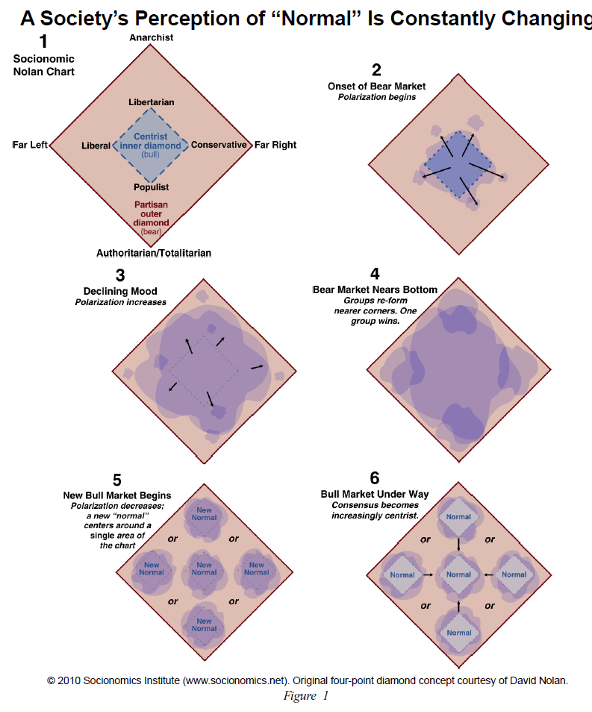
The first image in Figure 1 is our adaptation of the Nolan Chart, a simple diagram that depicts these complex political dynamics. David Nolan posits that left-wing liberalism advocates personal freedom, and that right-wing conservatism advocates economic freedom; libertarians advocate both, and authoritarians neither. We added the inner diamond to Nolan’s picture to show the distinction between the consensus that occurs during a bull trend and the polarization of views during a bear.
Images 2 through 6 in Figure 1 portray how a society’s perception of what is “normal” shifts over time.
Snapshot of bull market, with the consensus view arbitrarily positioned in the center.
Beginning of Bear Market: Polarization begins. People abandon the consensus view.
Mood decline accelerates: Polarization increases, as do calls for separation, opposition and destruction of the status quo. Society’s sense for what is “normal” loses definition.
Majorities form and one prevails: Society’s new normal gels nearer one of the corners.
Mood trend bottoms, reverses: A new bull market begins. Polarization decreases. Partisans begin to embrace compromise and re-form a centrist view.
Bull market under way: Society desires peace and cooperation. Optimism and willingness to compromise prevail. “Normal” may begin a slow shift, but even as the perception moves, society maintains consensus.
A large-degree mood reversal can accomplish a dislocation of views in a relatively short time. Large-degree bear markets can lead to calls for freedom, authoritarianism, left-leaning and rightist solutions. Where a country ends up is unpredictable. What is predictable is that societies tend to look far different after major mood declines than they did before them.
[Editor’s Note: In the decade following our call for increased polarization, the world was torn asunder by a series of severing events such as Occupy Wall Street, the Tea Party movement, Brexit, #MeToo, the anti- vs. pro-Covid vaccine tranches, in-fighting and division among the two-main political parties, a deadly insurrection of the White House, two impeachments of President Donald Trump, and on, all leading to “the most divided America since the Civil War (The Australian March 15, 2022).”]
Epidemics: Spanish Flu to Covid 19
May 2009 Socionomist:
Our socionomic and Elliott wave analysis suggest that social mood has completed an upward wave of monumental size and shifted to the negative at Grand Supercycle degree—which is one degree larger than the change in mood that created the Great Depression. This shift is driving rapid changes for the worse in financial markets, economies, personal fortunes and the quality of life. The scale of this mood shift means that the bulk of the largest bear market since 1720 still lies ahead, increasing our risk of an encounter with one of the grim reapers of major social mood decline, epidemic disease.
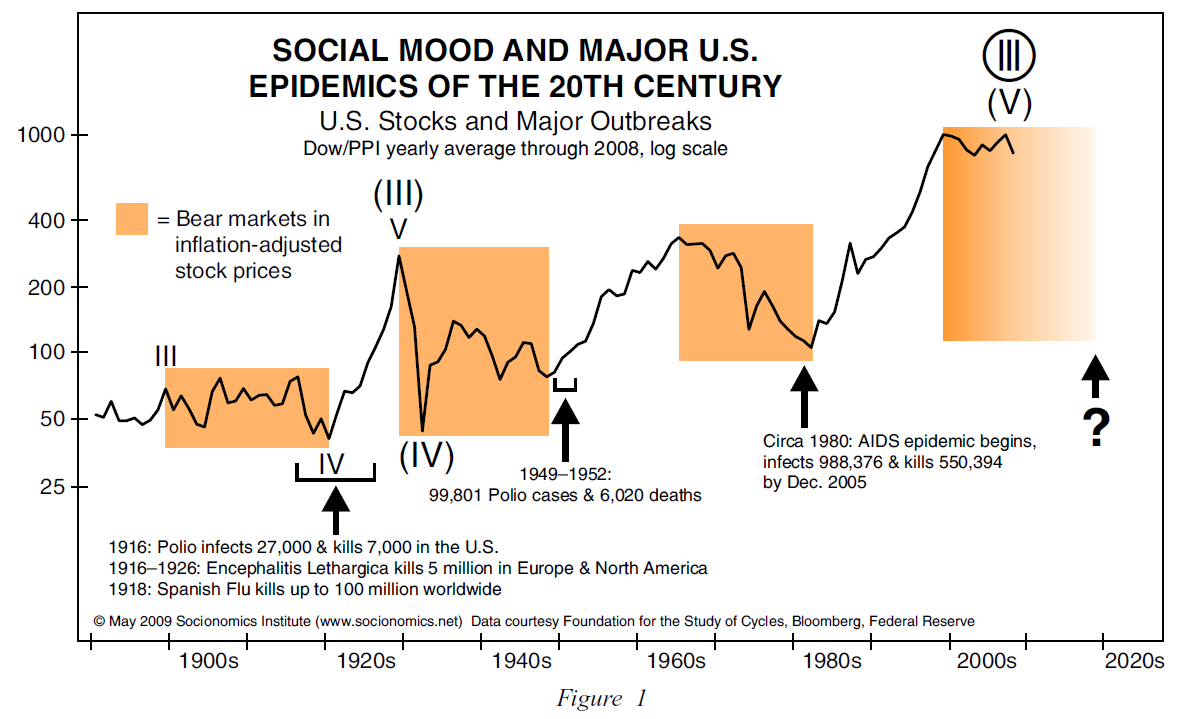
Social stress is rising as we approach another of these dangerous junctures, far bigger than the previous three. It should bring one or more epidemics and, could culminate in a pandemic.
Our analysis suggests that human health and quality of life have passed a historic pinnacle, the point from which major declines begin. Confidence and complacency are hallmarks of extremes in positive social mood. Recall that in the late 1960s—near a major peak in inflation-adjusted stock prices that held for 27 years—Surgeon General William Stewart famously declared that it was time “to close the book” on infectious disease. Yet new outbreaks have come steadily, including: Legionnaire’s disease, hantavirus, West Nile virus, drug-resistant tuberculosis, AIDS, salmonella, bird flu and the threat of old diseases returning through drug-resistant bacteria and viruses.
Today—more than eight years into a Grand Supercycle bear market—social mood is growing more negative and undermining confidence in government. Should a major epidemic break out now, people will be even more contentious and skeptical of government-run immunization. Lawyers will be all the more ready to sue for any perceived misstep. Government, the experts, the media, pharmaceutical manufacturers and insurance companies will all be mired in the fuzzy thinking that is typical of a bear market. They will likewise dance the discordant waltz that played out in 1976—but on a larger scale and with greater stakes. Government efforts to stop an epidemic will probably resemble the financial bailout: a reactionary, design-as-you-go tragedy of errors. Unfortunately, medicine is so hamstrung by laws and regulations that manufacturers, doctors and patients are essentially barred from coming to their own conclusions about the proper course to take.
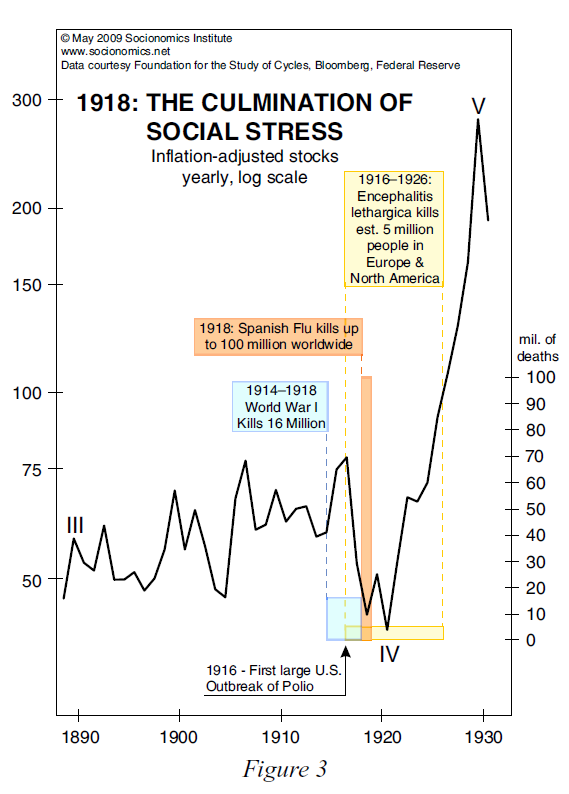
June 2009 Socionomist:
The Rising Baseline of Aggregate Stress, an Epidemic’s Ally
We are currently approaching another dangerous juncture in humanity’s fractal growth pattern. The roots run back to the year 2000, when the world’s stock markets peaked, marking the beginning of a large-degree negative trend in social mood and a substantial upturn in highly stressful events. The mood shift ushered in the 9/11 attacks, the War on Terror and a new U.S. military doctrine, the pre-emptive strike. Darker ideas have come to the fore: Torture has re-emerged as a theme in both military tactics and in entertainment.
Stress—born of the same fear that drives stock prices lower, tanks economies and escalates foreclosures—also increases the risk of disease. And foreclosure—being forced out of your home—is one of the most disruptive and stressful financial calamities that a family can suffer.
It is not surprising, therefore, that the list of epidemics in the news quietly continues to grow. Chronic kidney disease, Alzheimer’s, obesity, sexually-transmitted diseases, heart disease, meningitis, diabetes, cholera, Lyme disease and measles are all described by doctors as current epidemics, and whooping cough as a potential epidemic. AIDS continues to smolder, now extending its reach to older people. In 2008, dengue fever erupted into “one of the worst viral epidemics on record” in South America, Latin America and the Caribbean (Miami Herald, 5/17). Chikungunya, a mosquito-borne virus endemic to tropical Africa and Asia, has arrived in Albania and Italy. Satellite data research indicates a “significant risk” that dengue fever, malaria and Rift Valley fever will also enter Europe (Economist, 5/21). According to a Reuters report on May 19, U.S. scientists warn that a new, deadly pneumonia caused by drug-resistant “superbugs” is “spreading outside hospitals and represents a growing threat to the public.”
Like SARS in 2002, the 2009 swine flu erupted when the socionomic model said it would: after a strongly negative social-mood trend. Yet with social mood rebounding recently, the populace and media display complacency via swine-flu jokes, jewelry, t-shirts, songs and dances, and the widespread accusation that the World Health Organization overreacted to the outbreak. We have not seen the final bottom in social mood. More serious epidemics and more intense fear of disease will come later in the bear market, and jokes and t-shirt messages such as the one above won’t be considered funny or cute.
Emerging Pathogens
In the opinion of the U.S. Institute of Medicine, the next major infectious disease threat to the United States is likely to be a new variety of flu or a previously unrecognized pathogen like HIV was. Disease threats could compound: when human immunity reaches a nadir—such as in 1918—multiple pathogens find opportunity. Dr. Kate Jones of the Zoological Society thinks the next pandemic will come from wildlife via “human impact on areas of rich biodiversity that harbor pools of pathogens.”
Epidemics and Panic
Disease injures society in two key ways: (1) It depletes vital resources, overloading the health care system and sparking secondary health problems. (2) Panic often follows the outbreak of a pandemic, causing a wide range of associated problems. Crisis-level slowdowns already hamper the movement of goods, people and money; so a major pandemic—or even the threat of one—could seriously disrupt the global economy.
The Yale Human Area Relations File provides ethnographic reports of social responses to epidemics. They fit well with the social character of a bear market. The most frequently reported responses are “flight or migration away from the locus of the epidemic, extraordinary preventive and/or therapeutic measures, rejection of authority systems and scapegoating.” Thus, conflict will surely arise when an attempted exodus from an epidemic is met with a quarantine and travel ban.
Staying Healthy
As the bear market wears on, you will need to be more careful with social interactions, which have powerful effects on psychology and the nervous, endocrine and immune systems. Social stress can elicit undesirable responses, both in you and others. As negative social mood becomes more pervasive and contagious, your individual mental state becomes more critical. Thinking about frightening events can activate the nervous and endocrine systems just as real events do. Constant anxiety prolongs high levels of stress hormones, which suppress the immune system and raise the risk of depression.
A negative trend In social mood governs the character of Interaction across groups of all sizes, from nations to political parties, to communities, churches and one-on-one settings. We constantly respond to our social environment on multiple levels, and like the fractal patterns visible in Elliott waves and in much of nature, social interactions appear to affect physiology at all degrees of scale—from the caress of a lover to outright physical assault.
The Grand Supercycle bear market Is undermining social and physical health. Yet we can prepare for severe outbreaks of both social unrest and epidemic disease. A proper perspective will help you to gain situational awareness, optimize your attitude, and in turn your body and immune system
Here Is a list of the most Important things you can do to limit the impact of negative social mood on your health:
- Prevention is the best cure. Immunize your family. Wash your hands frequently. Exercise. Maintain good sanitation around your home.
- Be prepared for an extended stay at home should quarantines go into effect. Buy storable food and other supplies in advance.
- Selectively build community. In bear markets, people desire to belong to smaller groups, and you should not fight this trend. Ties with a close circle of friends create a safety net.
- Evaluate news of disease outbreaks. Google Flu Trends shows promise but had mixed results in forecasting the spread of swine flu.
- Monitor the status of the healthcare system.
- Continue to seek out high quality health care. Reserve cash to pay for it.
- Have basic reference material on hand, such as How to Be Your Own Doctor, by Carl E. Shrader, M.D.
And remember: When most people see no light at the end of the tunnel, that’s the socionomic signal that we are almost through it.
[Editor’s Note: In the decade following our prediction for a major epidemic, even pandemic event, the world was devastated by several major outbreaks, including: the worst Ebola virus in history in West Africa, 2013-6; the Zika virus, 2015-present, and the ongoing Covid pandemic, 2020-present, last count nine variants. Covid has been the worst pandemic since the 1919 Spanish Flu, plunging the global economy into the worst recession since World War II and propagating a parallel virus of mistrust and conspiratorial suspicion in scientific and government authorities.]
Marijuana Legalization Movement
July 2009:
THE COMING COLLAPSE OF A MODERN PROHIBITION
by Euan Wilson
History shows that mood governs society’s tolerance for recreational drugs. A rising social mood produces prohibition of substances such as alcohol and marijuana; a falling mood produces tolerance and relaxed regulation. In the case of alcohol, the path from prohibition to decriminalization became littered with corruption and violence as the government waged a failed war on traffickers. Eventually, as mood continued to sour, the government finally capitulated to public cries for decriminalization as a means to end the corruption and bloodshed.
We predict a similar fate for the prohibition of marijuana, if not the entire War on Drugs. The March 1995 Elliott Wave Theorist first forecasted the Drug War’s repeal at the end of the bear market, and in 2003, EWT stated that during the decline, “The drug war will turn more violent. Eventually, possession and sale of recreational drugs will be decriminalized.”
The Case of Marijuana
Social mood influences people’s actions and their social judgments. In times of positive mood, people have the resources to enforce their social desires.
They can afford to express the black and white moral issues preferred during bull markets, and drug abuse is a favorite target.
During times of negative mood, on the other hand, society’s priorities change. People have other, bigger worries and begin to view recreational drugs as less dangerous, if not innocuous in offering stress relief, pain reduction and the ability to cope with the pressures of negative social mood.
Over the past 100 years, governmental activities have manifested these changing attitudes. During periods of rising mood, policymakers stepped up regulation of cannabis. During periods of falling mood, they eased those same stances.
As shown in Figure 1, each legislative attempt to restrict marijuana use followed at least three, and in most cases four or five, bull-market years. In 1937, Congress passed the marijuana Tax Act. The law banned casual consumption of the drug and limited its use to specific medical and industrial purposes.
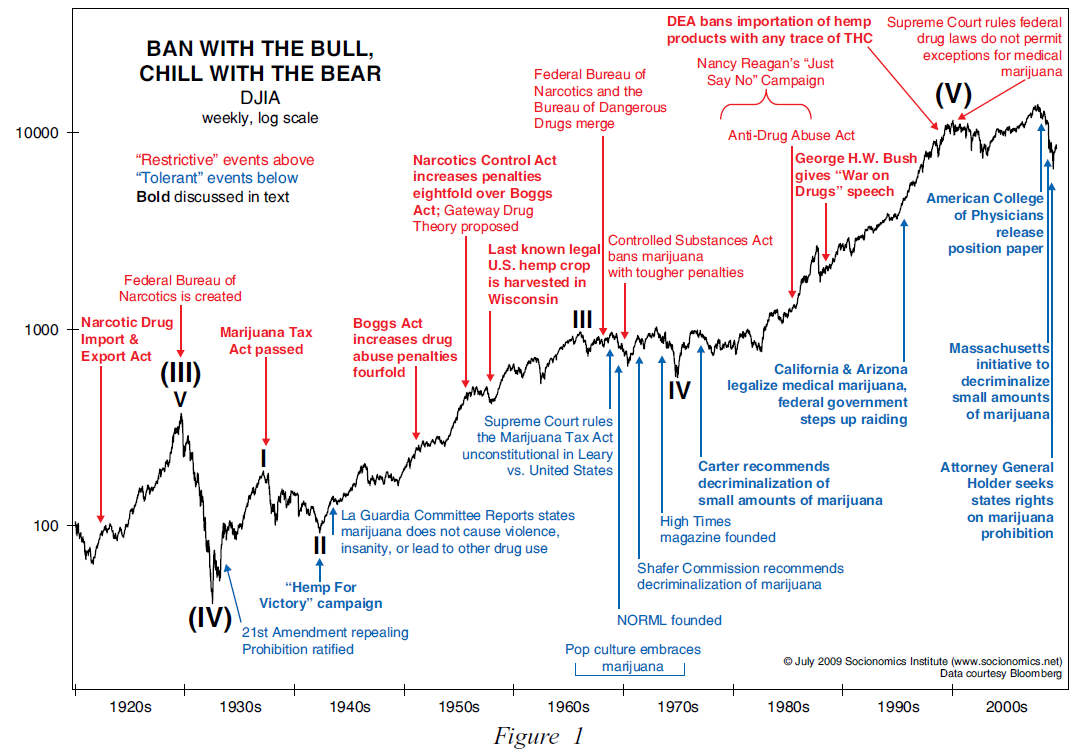
Franklin Roosevelt signed the law at the top of a roaring bull market, the Dow Jones Industrial Average having quintupled from its 1932 low. The real crackdown, however, came over a decade later during the massive wave III bull move. The Boggs Act, which increased drug use penalties fourfold, and the Narcotics Control Act, which increased penalties another eightfold, both came during the most powerful portion of wave 3 of III of the bull market. Then in 1958, after four more years of rising mood, Wisconsin farmers harvested the last legal crop of U.S.-grown hemp. In 1989, President George H.W. Bush’s famous “War on Drugs” speech came on the heels of seven years of net progress in the stock market. In 1999, a year before the top of the Grand Supercycle bull market, the DEA banned the importation of hemp products that contained even a trace of Tetrahydrocannabinol (THC), marijuana’s psychoactive ingredient.
Negative Social Mood Fosters Tolerance for marijuana Use
During bear markets, pot users have enjoyed liberal social tolerance. Figure 1 illustrates that the government tends to allow—and in some cases encourage—the growing of marijuana during bear markets. In 1942, the year Cycle wave II bottomed, Congress launched its “Hemp for Victory” campaign to encourage farmers to grow the crop for industrial purposes related to the war effort. According to the Wall Street Journal, farmers planted over 50,000 acres of hemp in 1942 and 240,000 acres in 1943. In 1977, a bear market year, President Carter recommended that Congress legalize possession of small quantities of marijuana. An exception occurred in 1996, when, four years before the top of a historic bull market, California and Arizona voted to allow the use of marijuana for medical purposes. But the federal government maintained consistency with the spirit of the times and stepped up its raids on marijuana facilities in the states where it was legalized and wrenched convictions from juries who were denied the information that the drug dispensaries were legal in those states, according to the New York Times. But in 2008, as social mood and the stock market plunged at its then-fastest rate since the 1930s, Massachusetts voters took a bigger step in passing an initiative that decriminalized the possession of small amounts of marijuana. Michigan’s voters also passed a loosening law, this one permitting the use of medical marijuana. On June 29, Oregon’s House of Representatives passed a bill in favor of licensing hemp farming. Barring a veto, Oregon will be the sixth state this year to pass pro-hemp legislation. So far, in keeping with the bear market trend, the feds have chosen not to interfere in these recent initiatives.
In February, U.S. Attorney General Eric Holder announced his view that states should make their own rules on medical marijuana use and that federal raids on pot dispensaries should cease. Then in June, Congressman Barney Frank introduced two pieces of marijuana-related legislation: the first allowing states to pass medical cannabis laws without interference from the federal government; the second eliminating federal penalties for possessing 100 grams of pot or less (but adding a fine of $100 for public consumption). According to CBS, Frank filed a similar bill last year that failed. We expect the current legislation to fail too, as it is too early in the bear market for Congress to take such contrary measures. But bills similar to Frank’s will gain traction when mood resumes its drop. Cash-strapped states will surely argue that they desperately need tax revenues from pot and that they can also save money by releasing non-violent drug offenders from prison.
Non-legislative groups are already proposing tolerance. In 2008, the prestigious American College of Physicians, the largest medical specialty organization and second largest physician group in the U.S., released a position paper urging the government to remove marijuana from its Schedule 1 classification. The drug has held the S1 designation for 38 years. It is a classification reserved for drugs, including heroin, that the government considers to have no medical uses and to possess a “very high potential for abuse.” The recent cry for reclassification from such a recognized body is a prime example of how changes in social mood modify attitudes toward the drug.
Finally, a number of critics of the War on Drugs have emerged in the media. CNN’s Jack Cafferty posted an article in late March of this year titled, “War on Drugs is Insane.” The same month, The Economist declared, “Prohibition has failed; legalization is the least bad solution.” And in June, CNN aired an Anderson Cooper special report titled, “America’s High: The Case for and Against Pot.” As mood becomes even more negative, specials such as CNN’s will drop the “and Against” from their titles.
Media reports like these will gain sympathetic readers and viewers across America, but none of their arguments will be as compelling as the point that decriminalization will end the bloodshed.
The Blunt Reality: Prohibition and the Drug War
As the saying goes, “History doesn’t repeat itself, but it does rhyme.” The Wave Principle explains why. Each of the eight Elliott waves within a typical impulse and correction pattern has its own personality, as Frost and Prechter initially described in Chapter 2 of Elliott Wave Principle. Figure 2 provides an example of how these personalities express themselves similarly at all degrees of scale, with the magnitude of the expression often reflecting the magnitude of the trend.
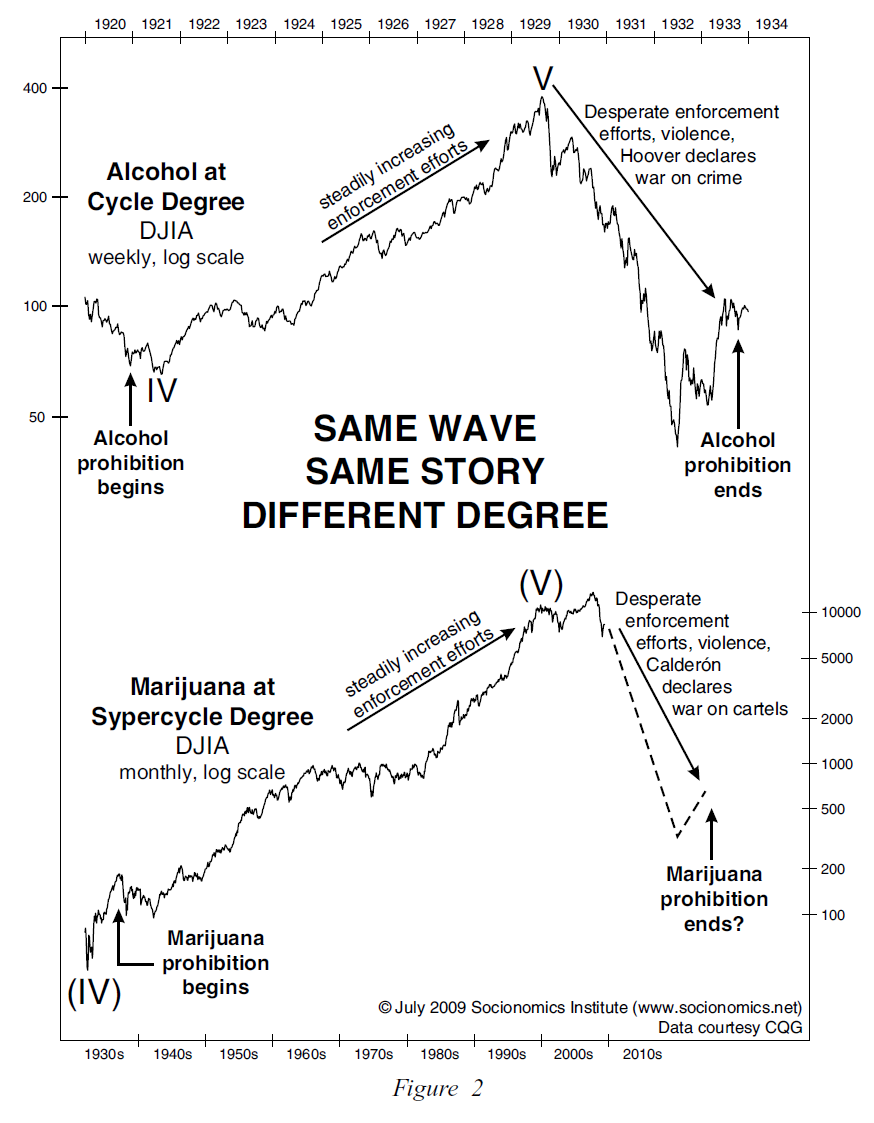
Today’s wave position is similar to that of the early 1930s, during Congress’ experiment with the prohibition of alcohol, an attempt that we believe is a useful analog for the current criminalization of marijuana.
March 2024 Socionomist:
Today, 24 U.S. states (plus Washington, D.C., and Guam) have legalized both the medical and recreational use of marijuana. The most recent vote came this past November in Ohio, with the Daily Mail commenting that “it’s been a tough 24 hours for America’s anti-cannabis movement. On Tuesday night, voters in conservative-leaning Ohio approved a measure legalizing recreational pot for adults.” More irony in this tale of changing laws: In 2023, an adult-use cannabis dispensary in New Jersey opened its doors, run by a formerly incarcerated man who had been convicted of marijuana-related crimes.
Cannabis and CBD (cannabidiol, which is a nonintoxicating derivative of hemp or cannabis) have become ubiquitous in food and beverage as well as health, wellness and beauty products. Annual revenue in the worldwide cannabis market has multiplied eightfold in the past eight years, and is projected to reach $100 billion annually by 2028.
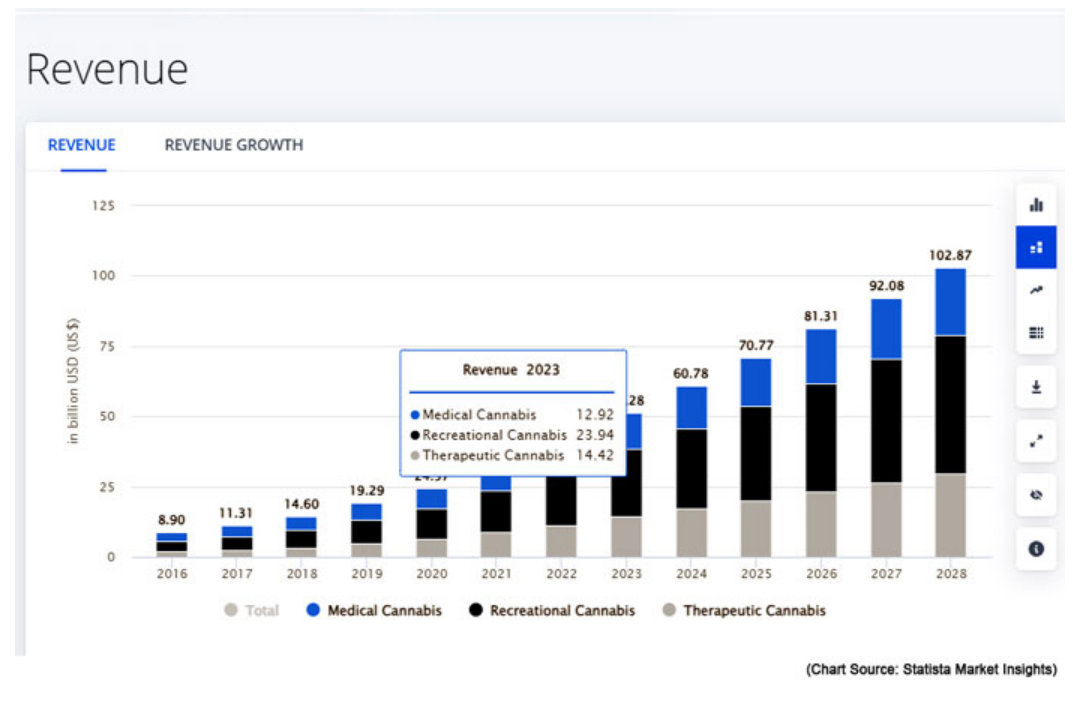
Beyond the legal right to smoke and ingest pot legally in 24 states, all investors can trade cannabis stocks and ETFs over the counter and via Nasdaq and the New York Stock Exchange.
In the most dramatic volte-face of all, new research shows that in truth, your brain on certain doses of certain drugs is not frying in a hot pan; rather, it’s firing on all cylinders, rewiring addictive patterns, and reversing mental health conditions such as PTSD and depression.
Social mood influences people’s actions and their social judgments. In times of positive mood, people can afford to express the black-and-white moral issues preferred during bull markets, and drug abuse is a favorite target.
During times of negative mood, on the other hand, society’s priorities change. People have other bigger worries and begin to view recreational drugs as less dangerous, if not innocuous, in offering stress relief, pain reduction, and the ability to cope with the pressures of negative social mood. Over the past 100 years, governmental activities have manifested these changing attitudes. During periods of rising mood, policymakers stepped up regulation of cannabis. During periods of falling mood, they eased those same stances.
The needle of public perception, federal and state policy, and mainstream media has swung more toward tolerance and permissiveness. In the October 2003 issue of The Elliott Wave Theorist, Robert Prechter wrote that “eventually possession and sale of recreational drugs will be decriminalized.”
From there, the cavalcade of states decriminalizing medical marijuana gained steam. Again, the July 2009 Socionomist report “The Coming Collapse of Modern Prohibition” anticipated the trend’s continuation and intensification: “The public will become open to what now may seem like radical ideas about how best to deal with marijuana use in society.”
And that’s exactly what transpired, as the pro-pot movement has since swept politicians, physicians and the American public into its fold, while dismissing the puritanical policies and views of yore:
In 2008, unlike Clinton, U.S. President Barack Obama openly admitted to “inhaling frequently. That was the point.”
The percentage of Americans supporting legalization of marijuana has gone from 42% in 2009 to 70% in 2023 – Gallup News, Nov. 8, 2023
By 2023 the medical use of cannabis is legal in 40 states and the District of Columbia. The recreational or adult-use of cannabis has been approved in the District and 24 states.
In 2022, President Joe Biden directed the Department of Health and Human Services to reclassify marijuana from a Schedule I narcotic (the most dangerous) to a lower classification.
Meanwhile, that Schedule I narcotic has fueled a legitimate cannabis-capitalist movement.
In the mid-to-late 19th century, marijuana was a staple of patent medicines, endorsed for its numerous health benefits. Doctors prescribed the “extract of hemp” to treat various ailments and relieve pain. And NYC socialites could pop into a smoky ganja house to indulge before the theater. It was the perfect cultural counterpart for waning social mood.
Today, medical journals tell of the health benefits of cannabis, along with other psychedelic substances including psilocybin, LSD, MDMA and ketamine. Consumers can buy endless varieties of cannabis-based edibles and medicinal tinctures from online dispensaries. On the streets of NYC you will find any number of legal CBD cafes. And the once-menacing figure of a shadowy pot dealer emblazoned in the culture of the 1980s is now … someone like my 80-year-old dad dispensing fully legal, fruit-flavored THC gummies on Christmas.
The “radical ideas about how best to deal with marijuana use in society” as predicted in the July 2009 Socionomist are here. Whether these new ideas are implemented or stifled nationwide will be a function of social mood. The more positive and optimistic people feel, the less likely that legal pot becomes as ubiquitous as liquor. The more negative and pessimistic they feel, the more likely that those who choose to do so can legally toke away to forget their troubles.
Other Frequently Asked Questions
What exactly is socionomics?
Socionomics is the study of how social mood motivates social action. It starts with the idea that changes in collective optimism and pessimism can influence behavior across financial markets, business, politics, popular culture and other areas of society.
How is socionomics different from traditional market analysis?
Traditional analysis often looks to economic reports, news events, earnings and other outside events to explain market behavior. Socionomics approaches the relationship differently. It views financial markets as expressions of social mood and examines how waves of social mood motivate trends in markets and society.
What does socionomics have to do with Elliott wave analysis?
Elliott wave analysis identifies recurring patterns in financial-market prices. Socionomics provides a broader framework for understanding why those patterns occur: They reflect naturally recurring changes in crowd psychology. Together, they offer two perspectives on the same underlying phenomenon.
Do I need to understand Elliott waves to use socionomics?
No. You can study and apply Socionomics without being an Elliott wave expert. If you already use Elliott wave analysis, however, socionomics can help you understand the social psychology behind the patterns you see in financial markets. By studying social mood, you’ll be better equipped to recognize market extremes in optimism or pessimism, identify developing risks and opportunities, and anticipate changing social trends.
Is socionomics only useful for investors and traders?
Financial markets are an important part of socionomic analysis, but its applications extend much further. Socionomic research examines how social mood relates to trends in business, politics, economics, consumer behavior, popular culture and other areas of society.
Does socionomics predict specific news events?
Not necessarily. Socionomics is generally more concerned with anticipating the character and direction of social trends than predicting a specific headline on a specific date. For example, changes in social mood may point toward increasing conflict, cooperation, speculation, risk aversion or changes in consumer behavior without specifying the exact event through which that trend will appear.
How can socionomics help me as an investor?
It can give you another way to evaluate the environment around financial markets. By studying social mood and crowd psychology, you may be better equipped to recognize extremes in optimism or pessimism, identify developing risks and opportunities, and consider where changing social trends could have an impact next.
Where should I start if I’m new to socionomics?
The Socionomist is a good place to begin. Each monthly issue applies socionomic theory to real-world developments, while subscribers also receive access to more than 100 past issues. For those who want to go deeper, the Socionomics Premier Membership includes The Socionomist along with the complete digital book collection, videos, academic papers, presentations and additional resources.sqaa
If news doesn’t drive the markets, what does socionomics say does?
Socionomic theory proposes that social mood is endogenously regulated, arising naturally from human interaction rather than being caused by outside events. Changes in social mood influence financial-market behavior and all kinds of social actions, which appear as events. Because markets move instantly, they sometimes move in ways that seem completely disconnected from the day’s headlines.
What is included with The Socionomist?
Your subscription includes the latest monthly issue of The Socionomist, where socionomic principles are applied to developing trends in markets and society. You’ll also receive access to more than 100 past issues, giving you a substantial library of real-world socionomic research and examples.
What is the Socionomics Premier Membership?
Socionomics Premier Membership is for readers who want to go beyond the monthly publication and explore the full body of socionomic research. It combines The Socionomist with our entire collection of resources for studying and applying socionomic theory.
Ready to get started? See your options below.
Subscriptions/Memberships:
Monthly Publication
The Socionomist

View Some Reader Testimonials >>
You get:
- New issue every month
- The Socionomist shows you how social mood shapes trends around the world. Each month, our analysts identify potential turning points in politics, fashion, music, health, family, religion, business and more — helping you prepare for what’s ahead, spot opportunities and avoid risks.
- Access to our archive of 100+ issues ($1200+ total value)
$277/yr
Not ready to subscribe? Try a single issue >>
Most Popular
Socionomic Premier Membership
You get:
- The Socionomist every month ($277/yr value)
- Access to our Archive of 100+ issues ($1200+ total value)
- Socionomics Digital Books Collection ($227 total value):
- Socionomics Film Series ($80 total value)
- Social Mood Conference Videos (2011-2016)
($178 total value) - Access to our catalog of exclusive videos, research papers, presentations and more. ($299+ annual value)
$2261+ $377/yr
Savings of 83+%
Order by Phone
Mon-Fri, 8am-5pm Et
Contact us at 800-336-1618 or 770-536-0309 (Internationally) and you will get a fast, friendly, knowledgeable person to assist you.
LIVE CHAT
Mon-Fri, 8am-5pm ET
Please use the LIVE CHAT button at the bottom right of your screen to chat with us.
We accept online payments from Visa, MasterCard, American Express, Discover, and Bitcoin through our online store. We also accept payment via PayPal, money order, bank wire, and check (drawn off a U.S. bank). If you would like to pay by any of these methods, please contact our Customer Care Representatives via phone, email, or live chat to place your order.
Socionomics Books & Collections:
We charge a flat $10 for shipping regardless of the number of books in your order.
Socionomics Collection
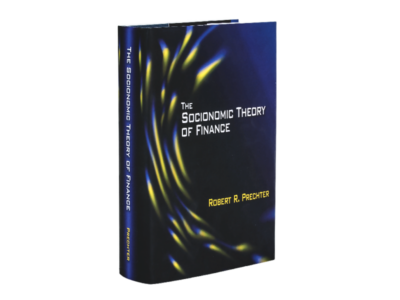


The Wave Principle of Human Social Behavior and the New Science of Socionomics
by Robert Prechter
$39
Hardback
You save 19%
Companion Collection
You save 32%
The Socionomics Film Series:
*All videos are available via streaming. We also have a limited number of DVDs for History’s Hidden Engine and Prechter at Oxford, Cambridge & Trinity remaining in our vault. Click “learn more” beneath those titles to secure your DVD before they’re gone.

History’s Hidden Engine
The unseen force shaping markets,
culture, and history.
Video | 2 hours
$19.99

The Socionomic Theory of Finance:
An Alternative to EMH and a Foundation for Technical Analysis
Video | 1 hr 10 mins
$19.99

Prechter at Oxford, Cambridge & Trinity:
Offering a New View of Financial
and Social Causality
Video | 2 hrs 40 mins
$19.99
Toward a New Science of Social Prediction
Robert Prechter speaks at the
London School of Economics
Video | 2 hours
$19.99
You save 25%
Social Mood Conference Videos:
$39 each
These videos allows you to experience the Social Mood Conference from the comfort of your home or office, with full access to every presentation.