Political unrest. Mounting debt. Growing financial uncertainty. France is making headlines for all the wrong reasons.
But the warning signs were visible in financial markets if you knew where to look. In June 2024, Elliott Wave International’s Murray Gunn identified a potential shift in France’s government bond market. By September 2026, that early warning had developed into an explicit forecast of a possible French sovereign debt crisis.
The story also raises a broader question: Could the same deterioration in collective psychology showing up in financial markets help explain France’s growing political and social unrest?
It Started With a Chart in June 2024
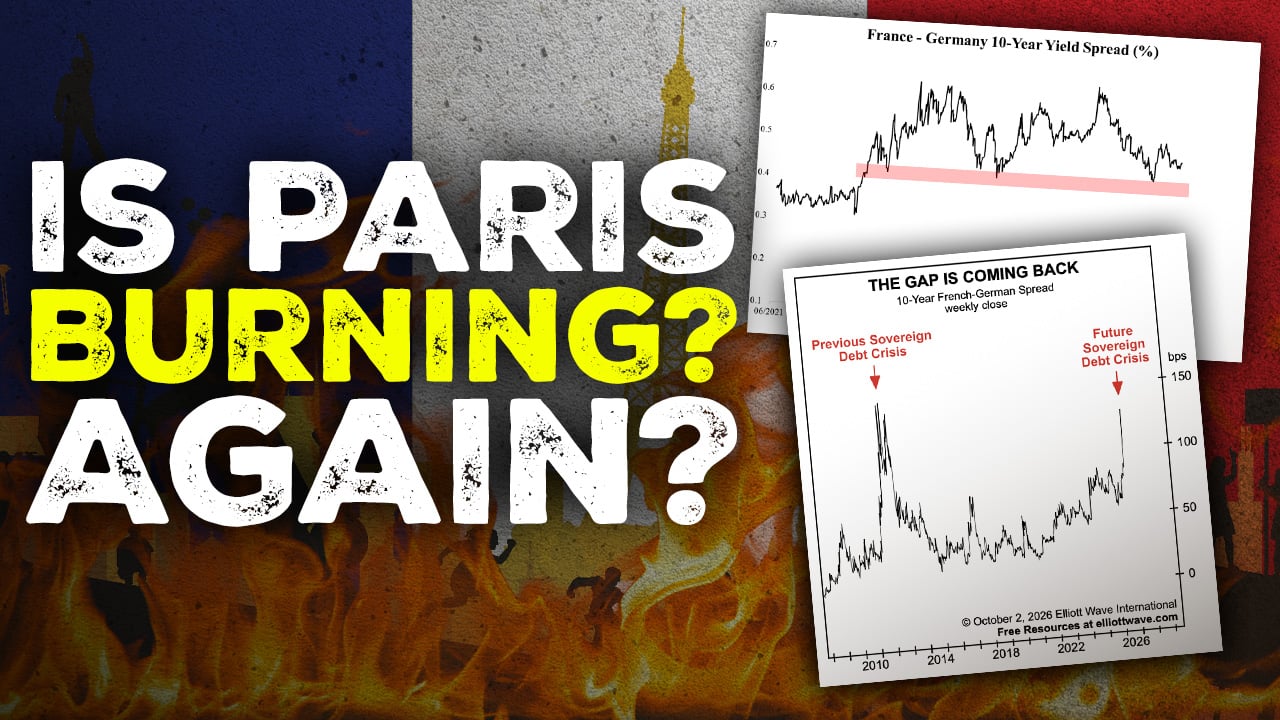
On June 3, 2024, Gunn focused on the yield spread between French and German 10-year government bonds. The spread had repeatedly found support just above 0.40% since 2022.

Daily Insight, June 3, 2024:
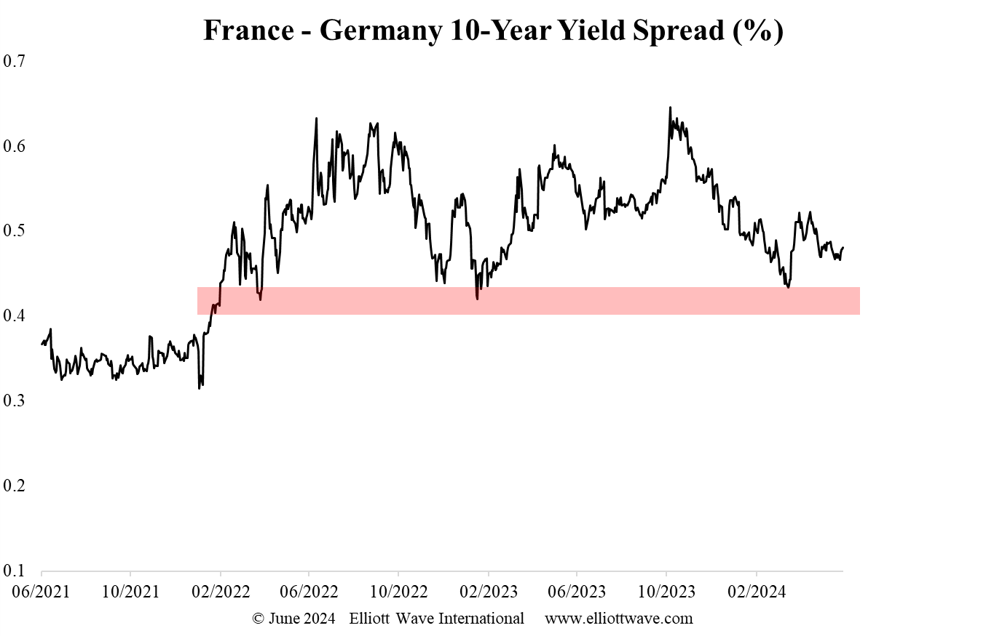
“This could be a clue that the yield spread is getting ready to widen, meaning French bonds underperforming.”
A widening spread means investors are demanding higher yields to hold French debt relative to German debt — a potential sign of growing concern about France’s finances. Gunn added:
“We’re watching the French – German yield spread closely. If it starts to tick up, expect increasing excitement in Europe, no matter which team wins the football.”
More than two years later, that warning had become considerably more serious.
“French Crisis Looming”
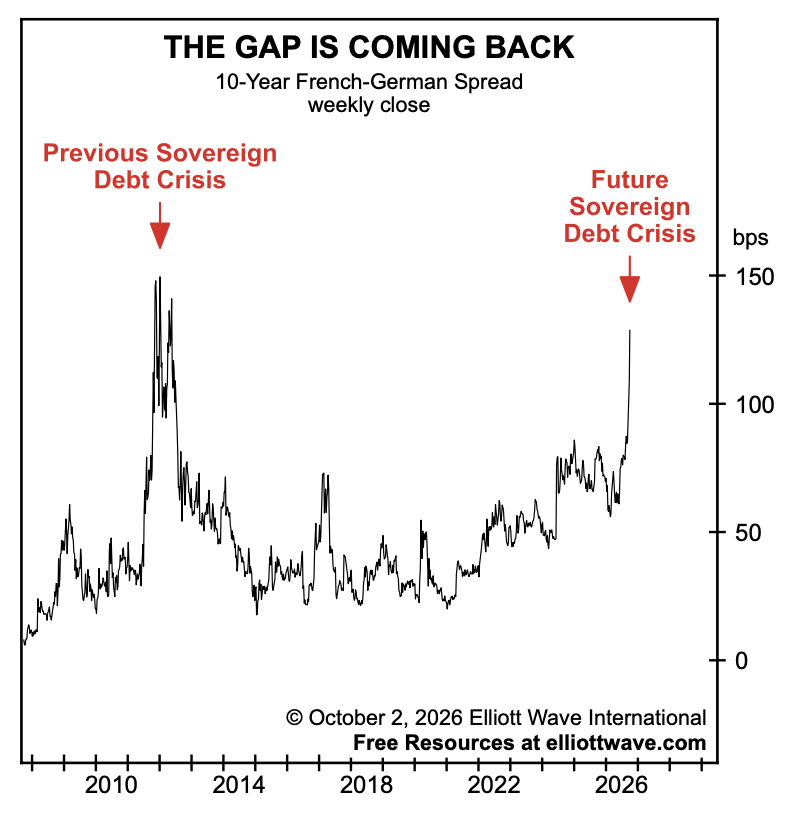
In September 2026, Global Market Perspective noted the “drip, drip, drip of steadily underperforming French government bonds.” Political instability, sluggish growth and mounting fiscal problems had made French debt appear increasingly risky.
The conclusion was blunt:
“Narratives differ amongst conventional analysts, but the market is telling us to be prepared for a French sovereign debt crisis.”
On September 18, France’s 10-year government bond yield reached its highest level since 2011, while the spread over German bonds exceeded 100 basis points for the first time in 14 years.
Markets, Mood and Social Unrest
That deterioration coincided with intensifying political divisions and social unrest — which is where Elliott wave analysis and socionomics intersect.
Elliott wave analysis studies recurring market patterns that reflect changes in collective investor psychology. Socionomics, developed by EWI founder Robert Prechter, extends that idea beyond markets, examining how changes in collective social mood may influence politics, culture and social behavior.
Conventional thinking tends to assume that political turmoil causes markets to weaken. Socionomic theory proposes something different: worsening social mood may independently produce both financial weakness and greater conflict.
When social mood is positive, optimism, confidence and cooperation tend to flourish. As it turns negative, distrust, polarization and conflict become more prominent.
France offers a striking example. Investors are demanding higher yields to hold its debt, political divisions have deepened, and public dissatisfaction has become increasingly visible. From a socionomic perspective, these are different expressions of the same deterioration in collective mood.
A bond spread cannot tell you when or where a protest will occur. But markets may offer clues about shifts in collective psychology before those shifts become obvious elsewhere.
And France Isn’t Alone
Similar strains are appearing across Europe. Italy has seen demonstrations over living costs and public services; protesters have confronted police in Belgium; and thousands have taken to the streets in Spain and Portugal over housing costs and economic pressures.
The grievances differ, but the pattern is familiar: financial stress, political division and social unrest are all becoming more visible.
And the Financial Warnings May Not Be Over
The October Global Market Perspective identified additional signs of weakness in European stock markets.
In France, small-cap and mid-cap stock indexes had peaked in late May 2026 — roughly 10 weeks before the blue-chip CAC 40.
By the time the October issue was published, those smaller-company indexes had already fallen approximately 10% to 15% from their respective highs.
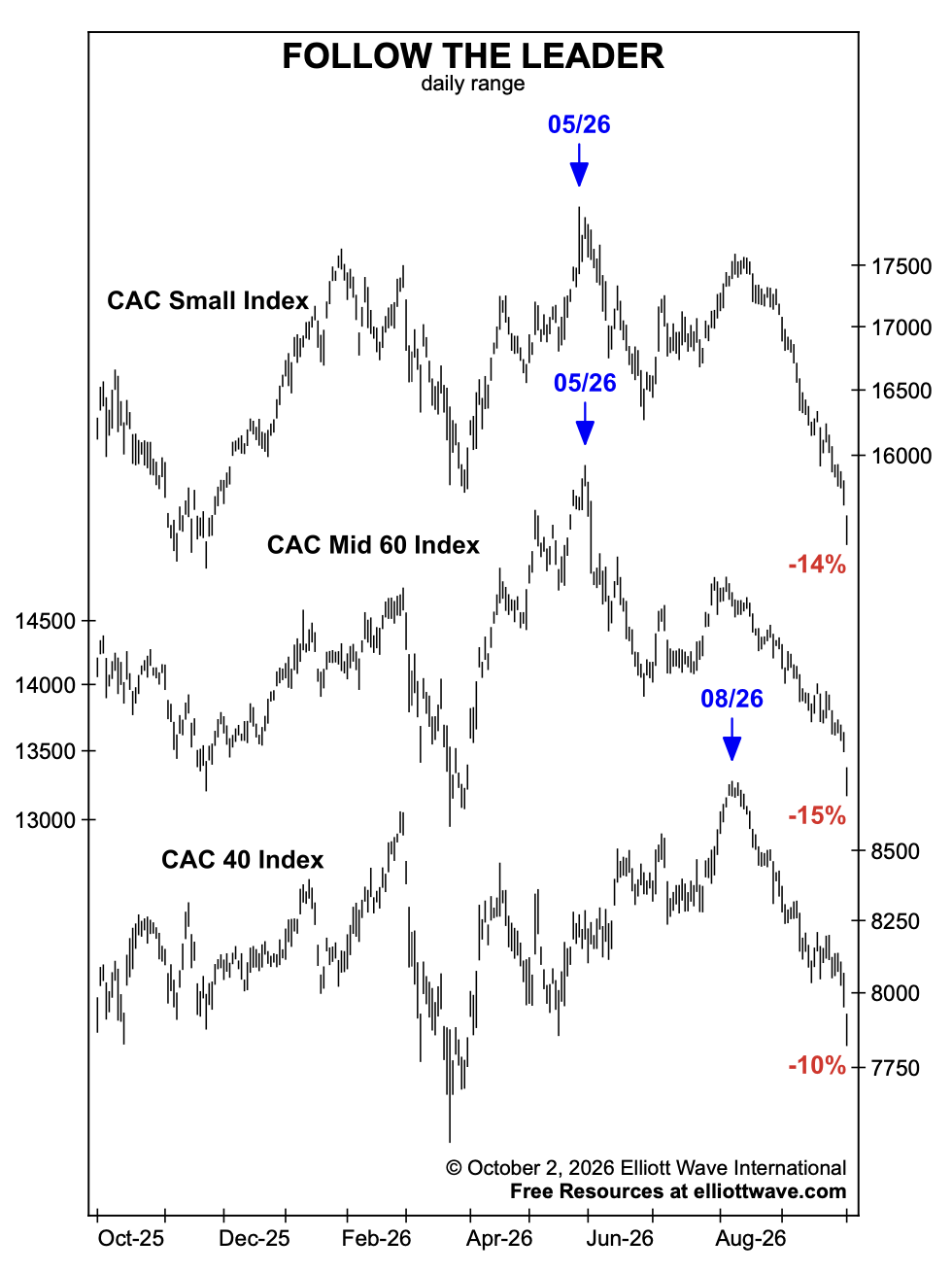
These developments suggest that the risks our analysts are monitoring extend beyond France’s government bond market.
And the Elliott wave patterns developing across Europe may provide further clues about what could happen next.
This is where EWI’s approach offers a distinctive perspective.
Elliott wave analysis helps identify potential turns in financial markets. Socionomics helps explain how the underlying shifts in collective mood may also manifest throughout society.
Together, they offer a way to look beyond the immediate headlines and examine the larger trends taking shape.
What Are the Markets Signaling Next?
France is just one of more than 50 markets covered each month in EWI’s Global Market Perspective. Twelve specialized analysts examine stocks, bonds, interest rates, currencies, metals, energy, cryptocurrencies and more, looking for developing trends, turning points, risks and opportunities.

While most commentary explains what has already happened, EWI’s analysts focus on what market patterns may be signaling next.
For the larger story beyond the markets, the Socionomics Premier Membership examines how shifts in collective social mood may influence politics, culture and society.


Murray Gunn Head of Global Research
Murray Gunn, MSTA, CFTe, CEWA, is Head of Global Research at Elliott Wave International. He worked as a fund manager in global bonds, currencies and stocks, including long posts at Standard Life Investments and the Abu Dhabi Investment Authority. Prior to joining EWI, he was Head of Technical Analysis at HSBC Bank. Murray is the author of the 2009 book Trading Regime Analysis and a contributor to Socionomic Studies of Society and Culture (Socionomics Institute Press, 2017). Murray is at the helm of EWI’s Global Rates & Money Flows and The European Short Term Update, while also providing commentary for Global Market Perspective.