Global Rates & Money Flows editor Murray Gunn has been warning subscribers about Nike for more than two years.
The Original Warning:
In May 2024, Nike was trading around $95.
At the time, despite the fact that Nike’s share price had already fallen nearly 50% from its 2021 peak, there was little in the company’s reports or communications to suggest anything was seriously wrong.
But Murray showed this chart to subscribers and wrote:

May 31, 2024:
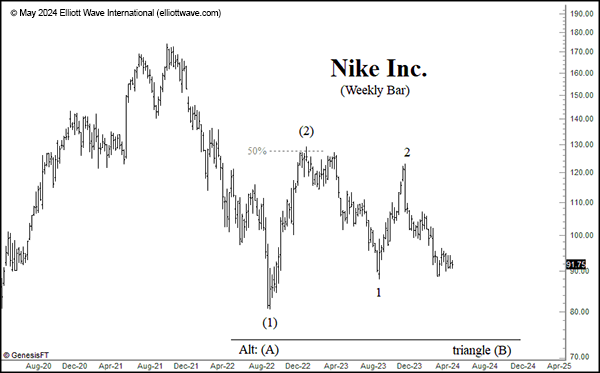
“From an Elliott wave perspective, the initial collapse into 2022 can be labeled as wave (1) of a much larger decline, with wave (2) ending at the 50% retracement of wave (1). The alternate wave count is that the initial decline was wave (A) and the movement from there is tracing out a triangle wave (B). Under either scenario, we can anticipate an ongoing decline in the share price of Nike. Nike sneakers? Sure. Nike debt? Perhaps just don’t do it.”
“Just Avoid It”
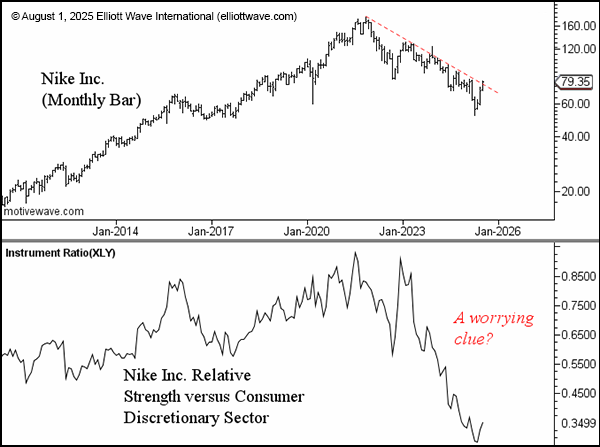
By August 1, 2025, Nike had fallen roughly 70% from its November 2021 peak.
Undaunted, most of Wall Street again ignored the chart and expressed optimism. Nike had recently issued an upbeat earnings report, and its CEO expressed confidence that the company’s months-long sales decline was beginning to ease.
And Murray? Well, Murray remained cautious.
This time, he pointed to Nike’s relative strength. The stock had significantly underperformed the Consumer Discretionary sector — something GRMF considers an important warning when evaluating a company’s debt.
Murray’s message to subscribers was simple: “Just Avoid It.”
August 1, 2025:
Just Avoid It.
“This is a clear warning to corporate debt investors that Nike’s problems mean it would be best to avoid the chance of any nasty shocks.”
What Happened Next:
Since that August 2025 warning, Nike’s share price has AGAIN been cut in half, now trading near $35/share.
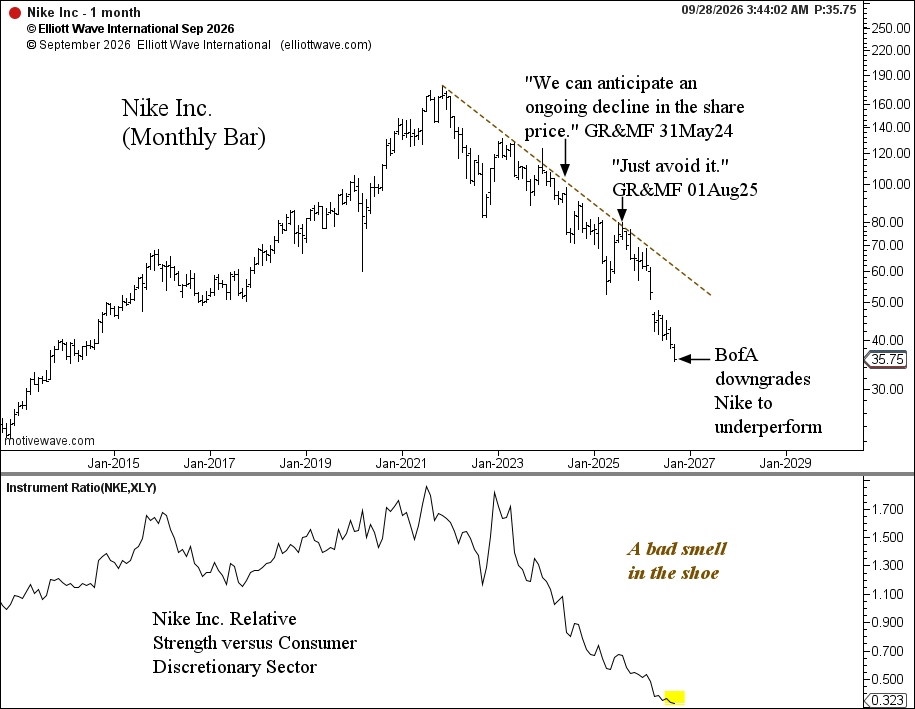
And Wall Street’s mainstream cheerleader prognosticators? At the end of last week, with Nike down 80% from its all-time high, Bank of America FINALLY downgraded Nike from “neutral” to “underweight,” citing concerns including a delayed turnaround, declining sales and dividend pressure.
Murray’s response?
“Mainstream forecasting? Just don’t do it!”
And despite the magnitude of Nike’s decline, Murray notes that 38 of the 44 analysts tracked byThe Wall Street Journal STILL rate the company “hold,” “overweight” or “buy.”
Murray’s GRMF view remains decidedly different:
“Our message remains clear. Until the relative strength turns up, stay well away.”
See What Murray Gunn Is Saying Now
Global Rates & Money Flows helps you look beyond the conventional Wall Street narrative to identify developing opportunities and risks across global bonds, interest rates, currencies and related markets.
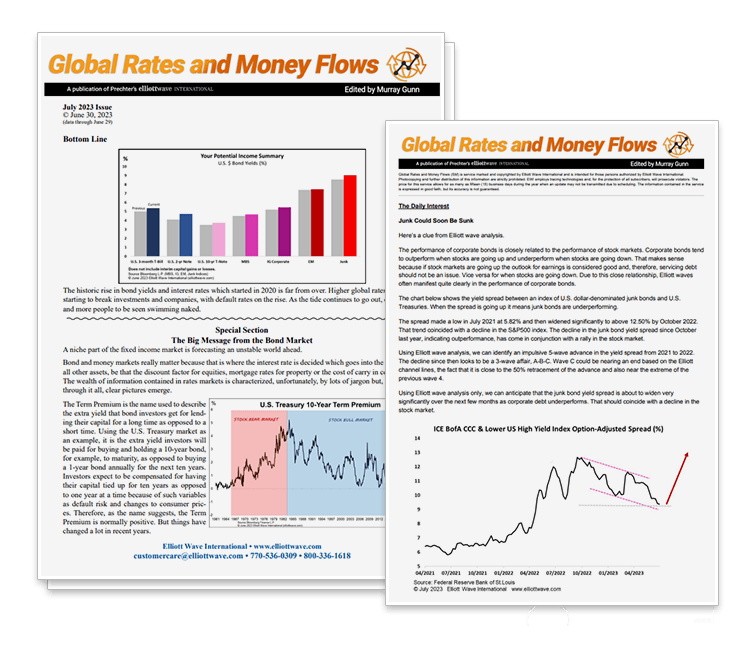
See the markets and relationships Murray Gunn is watching now — and what they may be signaling for investors next.
Want a Broader View of the Global Markets?
Global Market Perspective brings together EWI’s team of specialists to cover 50+ of the world’s most important markets each month — including global stock indexes, interest rates, currencies, metals, energy, cryptocurrencies and more.

Get Elliott wave analysis and forecasts across the major markets and regions around the world — all in one publication.

Murray Gunn Head of Global Research
Murray Gunn, MSTA, CFTe, CEWA, is Head of Global Research at Elliott Wave International. He worked as a fund manager in global bonds, currencies and stocks, including long posts at Standard Life Investments and the Abu Dhabi Investment Authority. Prior to joining EWI, he was Head of Technical Analysis at HSBC Bank. Murray is the author of the 2009 book Trading Regime Analysis and a contributor to Socionomic Studies of Society and Culture (Socionomics Institute Press, 2017). Murray is at the helm of EWI’s Global Rates & Money Flows and The European Short Term Update, while also providing commentary for Global Market Perspective.