The United States just crossed a pretty remarkable financial threshold.
The federal government is now spending about $1.25 trillion a year just to pay interest on the $40 trillion national debt.
There are of course the usual suspects: profligate spending, bureaucracy, lack of accountability, waste.
How did we get here?
For years, the U.S. government borrowed money at historically low interest rates, a real gravy train. And in 2020, the Fed’s expectation was that those rates would stay low for years.
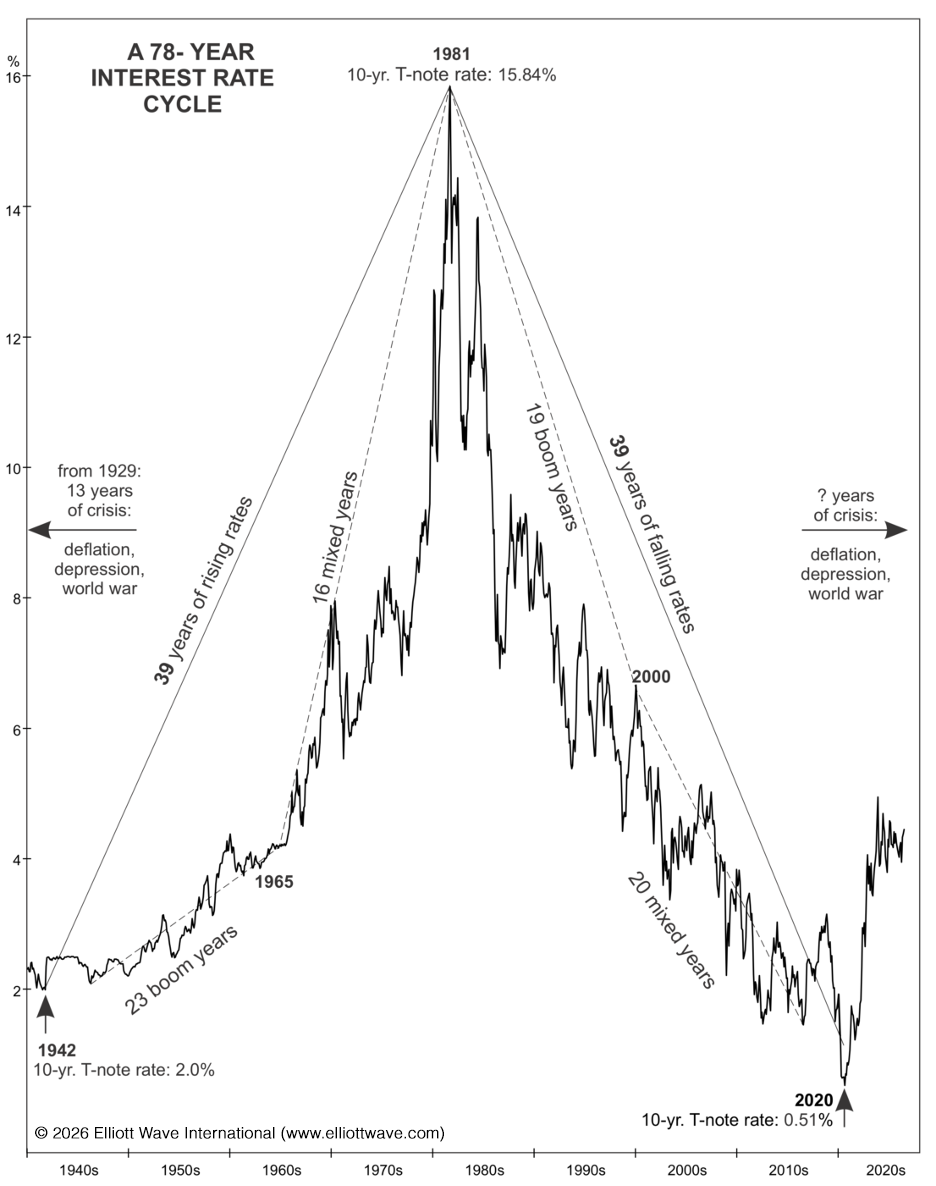
Take a look at this chart:
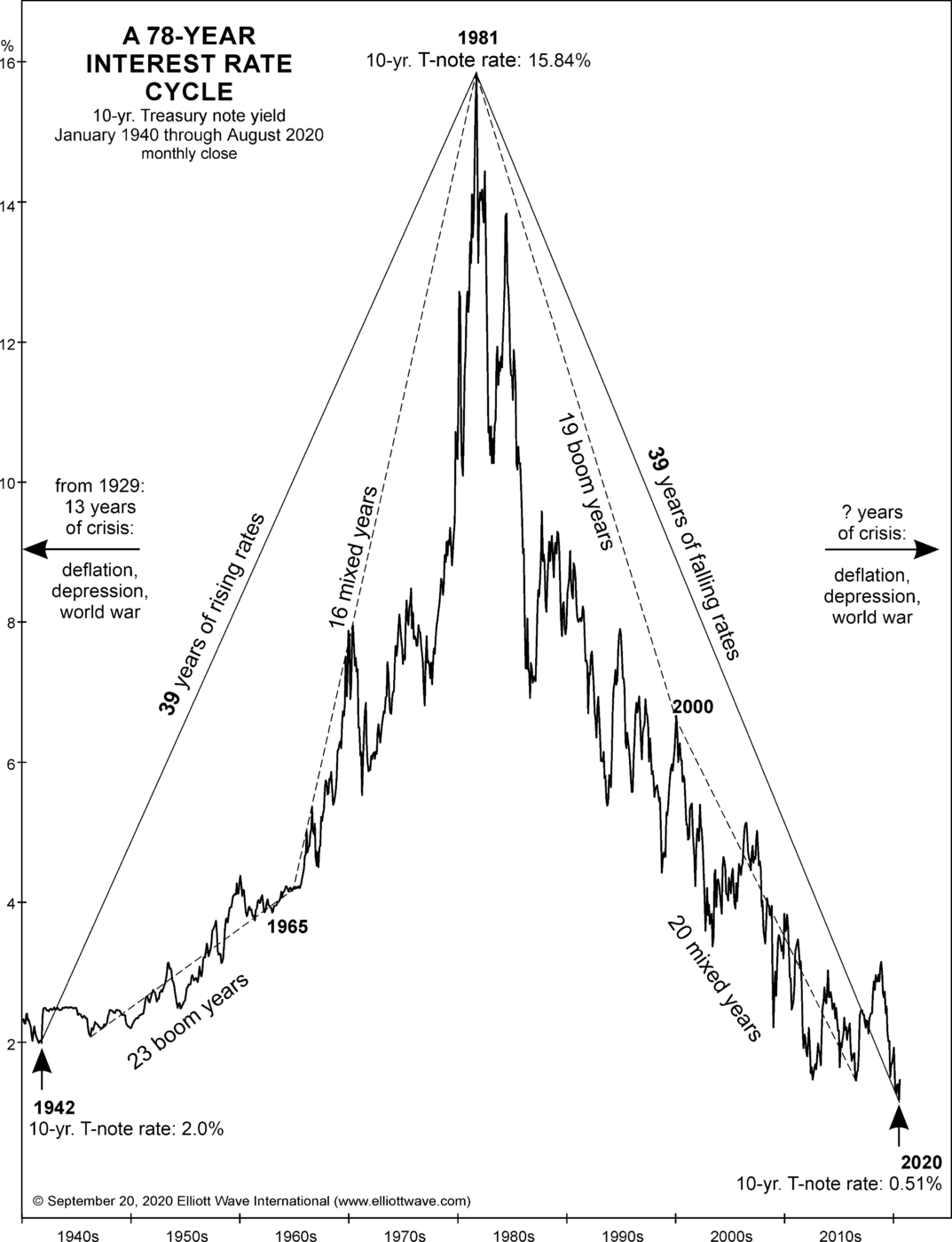
Interest rates rose from 1942 to 1981. Then they spent roughly 40 years trending lower, reaching historic lows by 2020.
At the time, there was little reason to believe — at least according to the conventional view — that things were about to change. In September 2020, Federal Reserve Chairman Jerome Powell told reporters that the Fed expected short-term interest rates to remain near zero for at least three years, through the end of 2023.
It made sense to almost everyone. The economy was still dealing with the effects of the pandemic, inflation was subdued, and the Federal Reserve was providing extraordinary monetary stimulus.
Besides, who would ever doubt the Fed chairman?
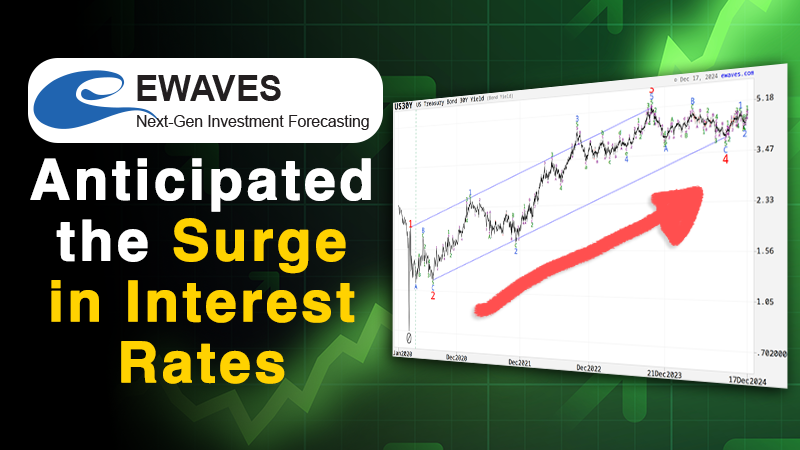
Analysts at EWI saw things very differently. And we put it in print for the world to see.
On September 23, 2020, The Elliott Wave Theorist addressed the Fed’s outlook directly:
“On September 16, Fed Chairman Powell…told reporters that he expected short term interest rates to stay near zero…through ‘the end of 2023.’ …there is not a chance in the world of that scenario playing out. The probability is high that interest rates have begun a process of rising….”
That’s a stark difference.
The Fed was telling investors to continue to expect near-zero rates for years. EWI was saying that the gravy train was OVER. Rates had bottomed.
And then look at what happened:
Rates rose across all time frames. Some, like 10-year yields, went up tenfold. T-bill rates that had been hovering near zero ultimately surged above 5%, rising 100-fold!
The four-decade era of generally falling interest rates had given way to something very different – with enormous consequences for investors and for debtors, including the federal government.
Individuals, businesses and governments who had built their future plans around the Fed’s completely incorrect assumptions and prognostications were caught in a nightmare scenario.
Fast Forward to Today
This chart shows a close-up view of the yield on the 10-year U.S. Treasury note since 2020.
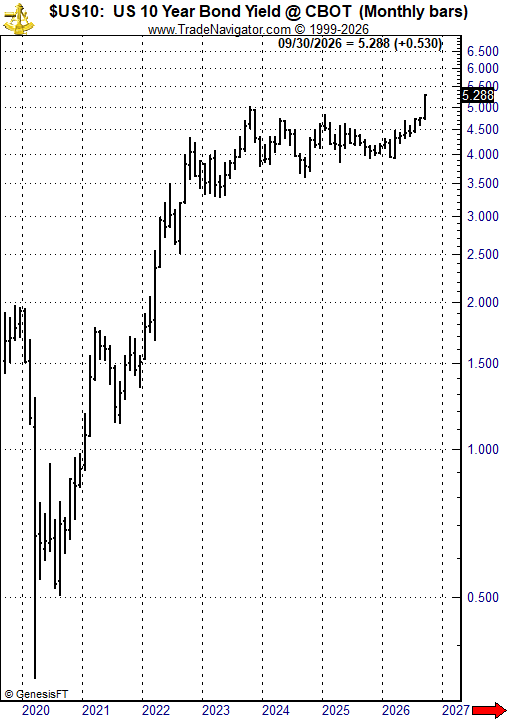
Today, as older government debt matures, some of it has to be replaced with new debt carrying substantially higher interest rates, contributing to the enormous $1.25 trillion annual interest bill.
And the effects of higher rates aren’t limited to Washington — mortgages, home-equity loans, commercial real estate and longer-duration car loans are all feeling the pressure as the effects spread throughout the financial system – and NOT just in the U.S.
This Isn’t Just Happening in America
While investors spend a lot of time wondering what the Fed will do next, long-term interest rates have been moving in some important ways around the world.
In Japan, for example, the 10-year government bond yield recently reached its highest level in 30 years.
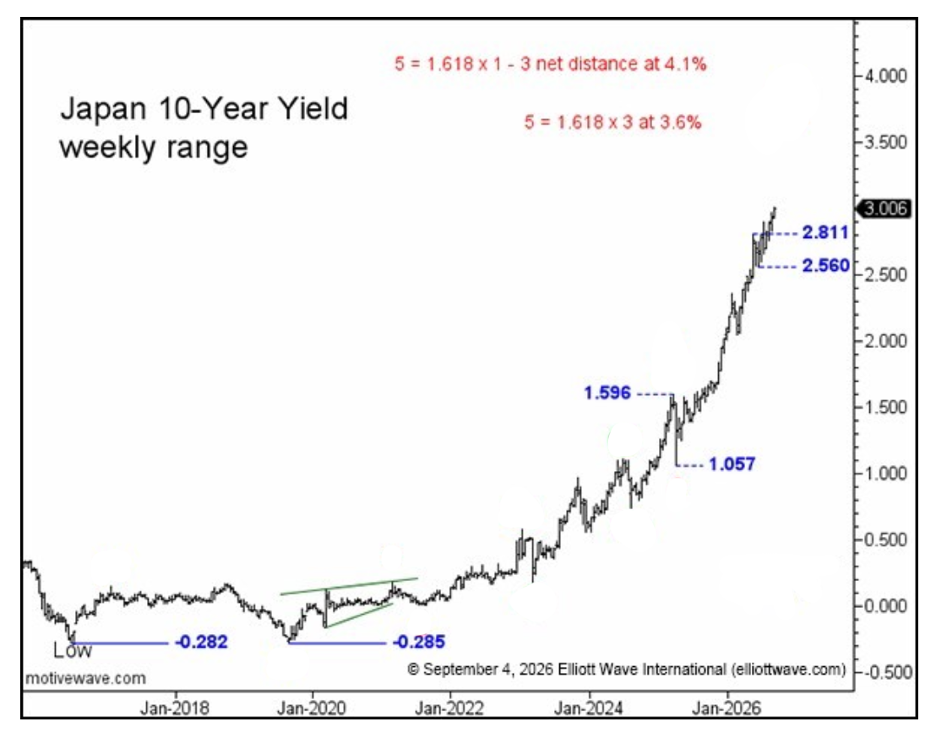
Government bond yields in several other major economies have also been moving higher.
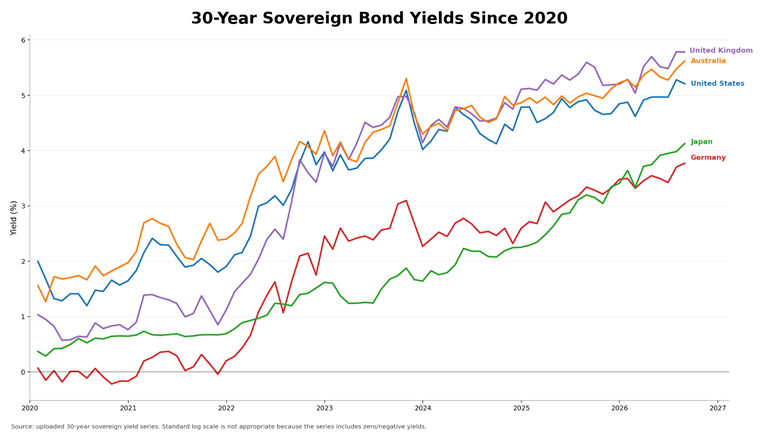
Remember how all this started. In 2020, economists agreed that ultra-low interest rates would stick around for years. EWI said the process of rising interest rates had already begun. Six years later, the U.S. is spending $1.25 trillion a year on interest. And a string of recent 30-year Treasury auctions has pushed borrowing costs to their highest levels in a quarter-century.
Which brings us to the question that matters now:
Where Do Interest Rates Go From Here?
Are higher rates now in the rear-view mirror?
Or could yields jump another one, two, or even five percentage points?
The implications of the next move will extend well beyond the bond market. They will impact:
Government finances.
Borrowing costs.
Housing.
Businesses.
Financial markets around the world.
The October issue of Global Market Perspective shows you what comes next.
GMP gives you our latest analysis across global interest rates, stocks, currencies, metals, energy, cryptocurrencies and more.
See EWI’s complete outlook for interest rates — including what our analysts believe the larger trend is signaling now.
Not ready to subscribe? Get more insights like this when you sign up for our free newsletter.