
An unfolding banking crisis in Paraguay raises a question Robert Prechter has been asking investors and savers for years: Is your bank safe?
Imagine waking up tomorrow and discovering you can no longer access your money.
Your bank’s app doesn’t work. Your debit card is useless. You can’t withdraw your savings or even access your paycheck.
And there’s no telling how long it will take to get your money back.
For millions of people in Paraguay, this isn’t a hypothetical scenario.
It just happened.
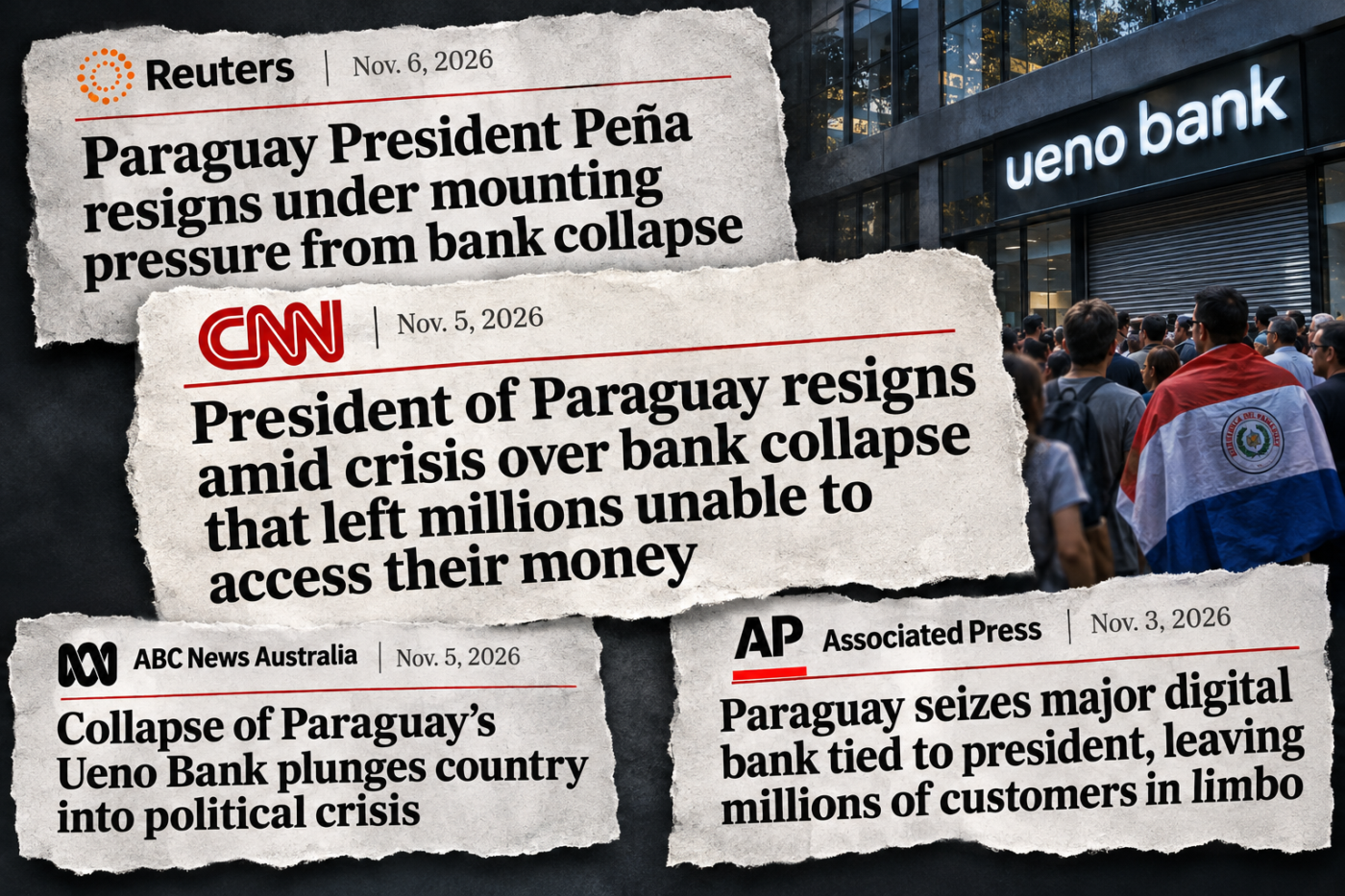
Ueno Bank, one of Paraguay’s fastest-growing financial institutions, just failed.
The bank, which served nearly 3 million customers, was placed under regulatory intervention after authorities discovered serious solvency problems.
Suddenly, customers found themselves unable to access their accounts. Savings, salaries and pension payments were caught up in the crisis.
Protests erupted. Government officials faced mounting pressure. And within days, the country’s president announced his resignation.
This event, which shocked everyone, raises an important question:
How safe is the money YOU have in the bank?
The Risks Most People Don’t Think About
For most people, a bank account represents security.
You deposit your paycheck, pay your bills, build your savings and assume the money will be there when you need it.
But banks don’t “keep” your money. They lend it out.
What happens when confidence is shaken?
The situation in Paraguay demonstrates how quickly financial problems can disrupt everyday life.
And while the circumstances surrounding Ueno Bank are specific to Paraguay, concerns about financial stability extend far beyond that country’s borders.
In France, mounting government debt and political uncertainty have raised concerns about the country’s finances.
Across Europe, elevated borrowing costs and sovereign debt vulnerabilities continue to challenge governments.
And in the United States, historically high stock valuations, enormous private and public debt burdens, and increasing market concentration have raised questions about the financial system’s true condition.
Even the International Monetary Fund has warned about vulnerabilities involving government debt, financial leverage and potential disruptions to financial institutions.
None of this means another global financial crisis is inevitable.
But it does make one thing clear:
Understanding the risks to your money matters — even when financial markets appear healthy. Why? Because that is when you want to act — before it’s too late.
Prechter Has Long Advocated Safe Havens
Prechter’s book, Conquer the Crash, a examines the potential consequences of excessive debt, excessive speculation, credit contraction and a deflationary depression.
And one of the central subjects he addresses is the safety of the banking system.
Prechter explains how an extended period of credit expansion can leave financial institutions vulnerable when economic conditions deteriorate.
He also examines what could happen to deposits, investments, pensions and other financial assets during a major contraction.
His concern isn’t simply that stock prices could fall.
It is that a severe financial crisis could affect the institutions people depend on to safeguard their wealth.
In the fully revised and updated Last Chance to Conquer the Crash, Prechter went further, offering readers practical guidance on preparing for difficult economic conditions.
One of the first questions on the book’s website is remarkably straightforward:
“Is my bank safe?”
It is a question millions of people in Paraguay forgot to ask.
You should ask it, wherever you live.
Prechter’s book does more than just ask the question. It tells you how to avoid getting stuck in the wrong bank.
Last Chance to Conquer the Crash also answers other questions such as:
- Is my pension safe?
- Which bonds are safe investments, and which might go to zero?
- Where can I find the safest money funds?
- How can I open accounts in the safest banks in the world?
- Where are the safest places to store gold?
- Can I make money in a crash?
- And more
The book also explores how deflationary pressures can affect stocks, real estate, debt and the broader economy.
And, perhaps most important, it offers specific steps you can consider taking to prepare for financial turmoil.
That way, when a financial crisis strikes, you will not panic because you will have already taken steps to be far safer than you are today.
Get Your Copy of Last Chance to Conquer the Crash
Discover Robert Prechter’s analysis of banking risks, credit contraction, deflation and the steps you can consider taking to protect your financial future.
Get the hardcover edition for $97, with instant access to the eReader version.
Or receive the eReader free with a three-month subscription to EWI’s Flagship Market Services.


